Expert Insight
Expert Insight: Xinyue (Hope) Shen on Spatial Narratives, Multidisciplinary Design, and the Intersection of Landscape Architecture and Conceptual Art
Curatone Art & Research Journal, Vol. 1, Issue 2 (2026)
Received: June 28, 2026
Accepted: July 2, 2026
Published: July 7, 2026
Keywords: Landscape Architecture, Spatial Research, Multidisciplinary Design, Conceptual Art, Material Narratives, Public Space, SWA Group, Cornell University.
Abstract: This interview documents the professional and academic journey of Xinyue (Hope) Shen, focusing on the synergy between large-scale landscape architecture, spatial research, and independent conceptual design. The text explores how an educational foundation spanning industrial design and landscape architecture shapes a unique design philosophy. Furthermore, it analyzes the methodology of translating environmental data, sustainability metrics, and emotional narratives into tangible public spaces and immersive art installations.
As part of Curatone.art’s ongoing research initiative, we feature Xinyue (Hope) Shen — an accomplished landscape architect, researcher, and multidisciplinary designer. This interview explores how the synthesis of rigorous environmental planning and conceptual artistic practice defines the role of a spatial designer in creating socially engaged and emotionally resonant environments for the 21st century.
Expert Biography
Xinyue (Hope) Shen is a Landscape Architect, an international designer, and an academic researcher currently based in the United States. She holds a Master of Landscape Architecture with a minor in Real Estate from Cornell University, as well as a Bachelor of Arts in Industrial Design from the Beijing Institute of Technology. Currently practicing at the world-renowned SWA Group, Xinyue contributes to high-profile international public, hospitality, and urban infrastructure projects across the United States, the Middle East, and Asia — including notable resort master planning in Egypt and Saudi Arabia.
Her multidisciplinary work has been recognized with prestigious global honors, including the ASLA National Student Honor Award (2021), the IDA Silver Award (2023), and multiple MUSE Gold Awards (2026) in Architectural Design and Experiential & Immersive Exhibition Design. Actively involved in academia, she has served as a guest lecturer and design critic at the University of Nevada, Las Vegas (UNLV), the University of Houston, and Virginia Tech.
Selected for the Curatone Annual Review 2026 (Academic Print & Digital Edition).
Xinyue, in your case, you have been involved with Industrial Design in Bachelor’s level, whereas at Cornell University, you have done Master of Landscape Architecture. Do you feel that the transition from designing on small scale objects to large-scale territories and ecosystems affects your design philosophy? Can you claim that having done Industrial Design brings something special to the large scale space design?
Yes, I think this transition has strongly shaped my design philosophy. My background in Industrial Design trained me to start from the human body, material, detail, function, and emotional experience. At Cornell, Landscape Architecture expanded this thinking to larger systems, such as ecology, infrastructure, climate, and urban context.
However, I do not see the two fields as completely separate. They share many similarities, especially in the design of outdoor furniture, paving, lighting, railings, play elements, and other human-scale landscape details. These elements operate between object design and spatial design, so my Industrial Design training can be directly translated into landscape practice.
I believe this background gives me a special perspective. It helps me connect large-scale ecological and territorial strategies with intimate human experience. I pay attention not only to the overall landscape structure, but also to how people sit, touch materials, move through thresholds, and emotionally connect with a place.
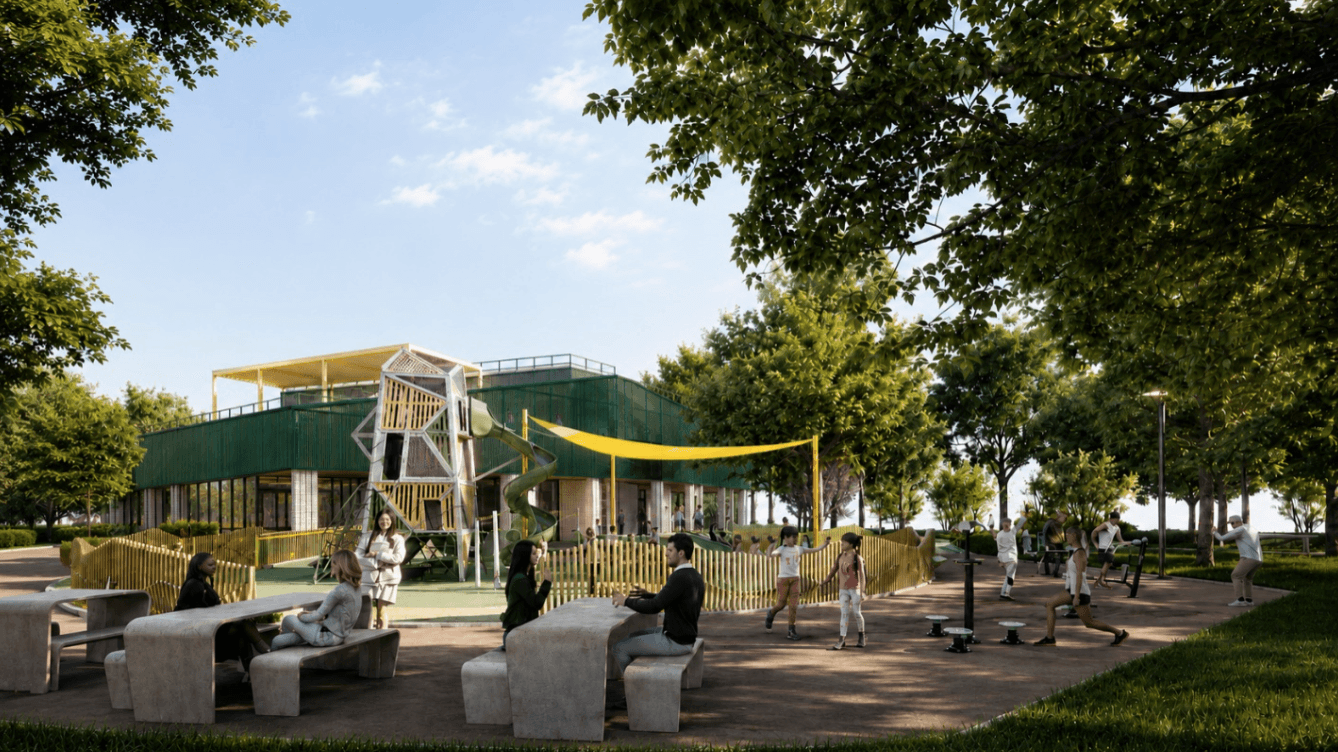
TIRZ 20 Southwest Civic Core in Texas Kids Playground / Courtesy of SWA Group
Now, at SWA Group, you contribute to high profile projects related to cities and hospitality, including TIRZ 20 Southwest Civic Core in Texas, historic hotels renovations in Luxor and Aswan and new streetscape designs in Neom, Saudi Arabia. How do you reconcile the need for cultural/historical preservation of the place with the need for ultra-modern sustainable and climate resilience strategies?
For me, cultural preservation and sustainability are not two separate goals. They can support each other if we understand the place deeply enough.
At SWA Group, whether I am working on TIRZ 20 Southwest Civic Core in Texas, historic hotel landscapes in Luxor and Aswan, or streetscape studies in Neom, I always start by reading the site’s cultural memory, climate, material language, and patterns of use. Preservation does not mean simply copying historical forms. It means understanding what gives a place its identity: its spatial rhythm, shade culture, planting traditions, local materials, views, rituals, and relationship with water and climate.
At the same time, modern sustainability strategies need to be embedded carefully. For example, climate resilience can be achieved through native and adaptive planting, stormwater management, shaded pedestrian networks, porous surfaces, heat reduction, and more efficient irrigation systems. These strategies can be expressed in a way that feels rooted in the local landscape rather than imposed as a foreign technology.
I see my role as building a bridge between memory and future performance. A successful design should protect the cultural atmosphere of a place while allowing it to respond to contemporary environmental challenges. It should feel historically respectful, but also resilient, usable, and alive for future generations.
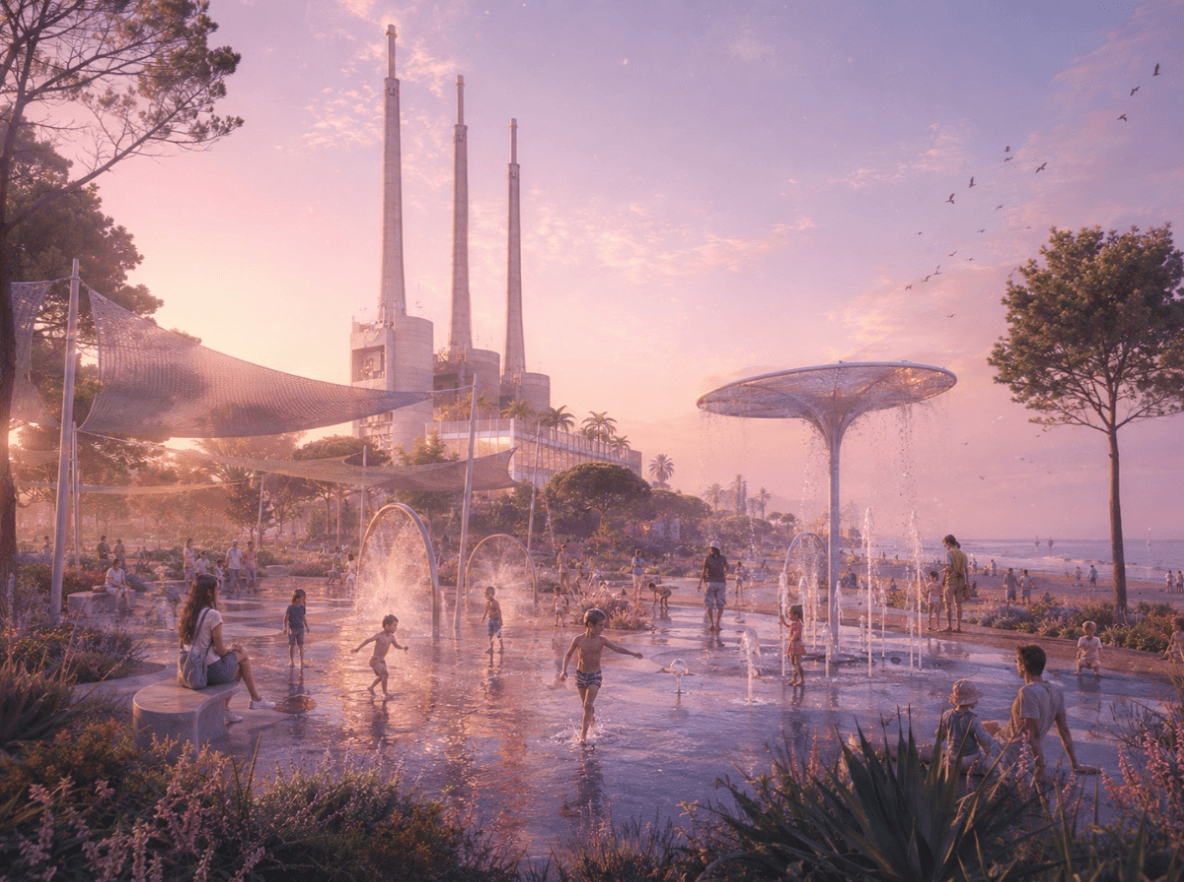
Barcelona Three Chimneys Coastal Wetland Park Kids Water Play / Courtesy of Xinyue Hope Shen
You have prestigious specialized certifications as LEED AP BD+C and SITES AP. In your opinion, how can modern landscape architects move beyond green checklists and create genuine "material narratives"—where sustainability is perceived and understood not only by functional needs but by the community itself?
For me, LEED and SITES are valuable frameworks, but they should not become the final goal. A landscape architect needs to translate sustainability into something people can see, touch, and remember. “Material narratives” mean that recycled stone, native planting, stormwater channels, shaded paving, or reused timber are not hidden technical solutions, but part of the spatial experience. When the community understands why a material is used and how it responds to climate, ecology, and local memory, sustainability becomes a shared cultural value rather than a checklist.
You received major awards in the industry, such as ASLA National Student Award, IDA Silver and MUSE 2026 Gold Awards for Infrastructure and Experiential/Immersive Exhibition Design. What approaches do you use when designing an award winning exhibit/experience translating spatial data into visual language that everyone can understand?
When I design an award-winning exhibit or experience, I try to turn complex spatial data into a clear human story. Data itself can be abstract, so the first step is to identify the emotional and spatial logic behind it: what people should understand, feel, and remember.
For projects such as Beyond the Concrete – The New Era of AI, I translated invisible systems- data flows, cooling infrastructure, heat reuse, circulation, and ecological buffers into visible spatial layers. Instead of presenting information only through charts, I use movement, sequence, material, light, planting, and immersive atmosphere to help people experience the data physically.
My approach is to make complexity legible. I simplify technical systems into diagrams, paths, thresholds, and moments of interaction, so that visitors do not need specialized knowledge to understand the project. For me, a successful exhibit is not only visually strong, but also educational, emotional, and accessible to the public.
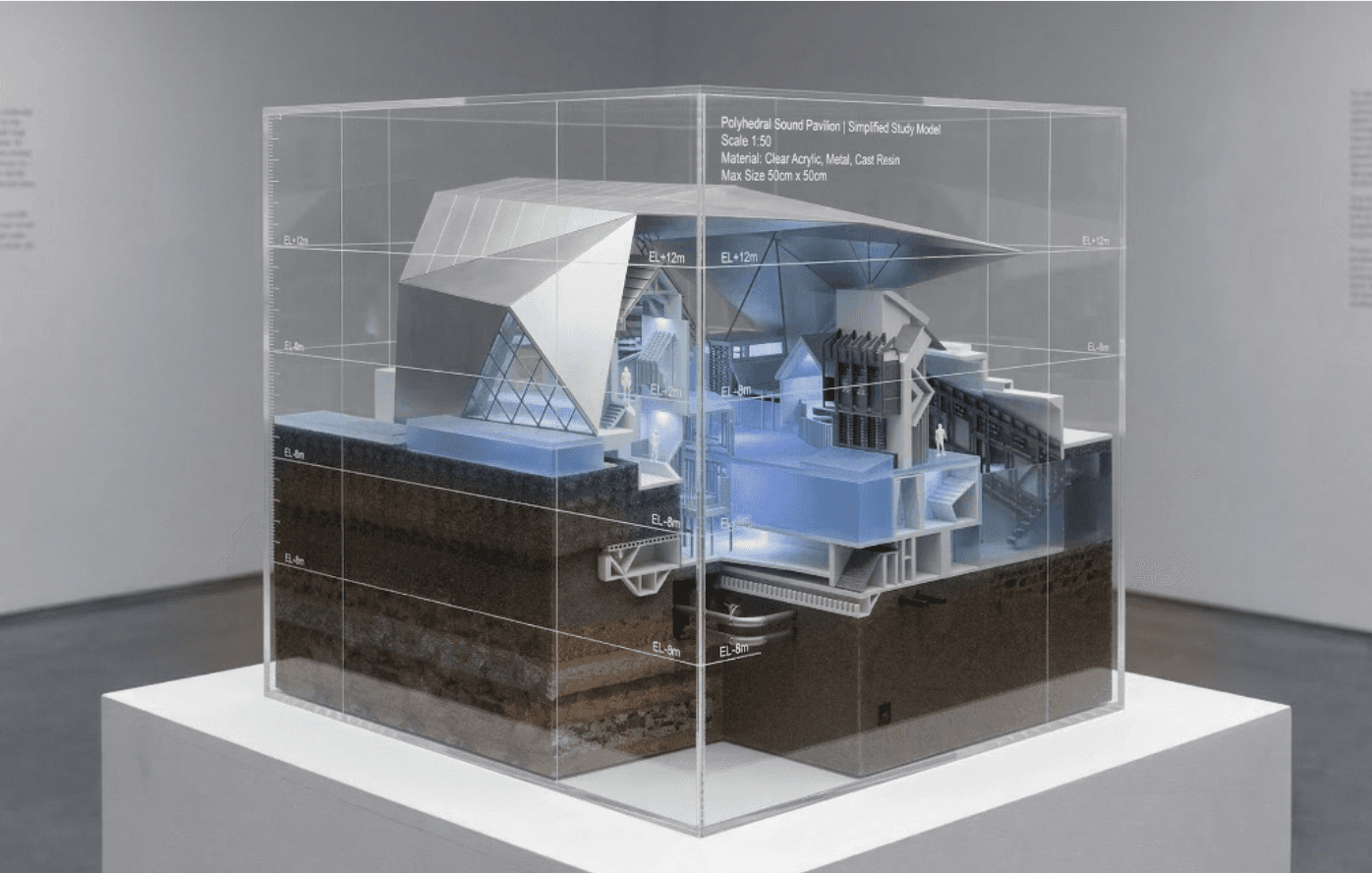
Beyond the Concrete- The New Era of AI Model/ Courtesy of Xinyue Hope Shen
You were one of the Jury members for the recent international "Connections" competition and evaluated a great variety of art and design submissions. Coming from your multidisciplinary background, which criteria were the most important when choosing works that translated deeply personal ideas into universal visual expression?
As a jury member, I was most interested in works that could transform a personal story into a visual language that others could emotionally enter. For me, the strongest submissions were not necessarily the most technically complex, but the ones with clarity, sincerity, and a strong conceptual structure.
I usually looked at three things: first, whether the work had an authentic personal voice; second, whether the visual expression was refined enough to communicate beyond the artist’s own experience; and third, whether the work created an emotional or intellectual connection with a broader audience.
Coming from a multidisciplinary background, I value works that balance concept, form, material, and atmosphere. A successful piece should not only tell a private story, but also open a shared space for reflection, memory, and interpretation.
As an active participant in development of the discipline, you are a frequent academic design reviewer at Virginia Tech, UNLV, University of Houston and other educational institutions. Judging by your extensive experience with young designers, what mindset shift or technological innovation will radically transform the public space architecture in the upcoming decade?
From my experience reviewing young designers, I think the biggest shift will be from designing public space as a fixed form to designing it as an adaptive system. The next generation will need to think beyond aesthetics and master climate, data, ecology, and social behavior together.
Technologically, AI and environmental simulation will radically change how we design. They can help us understand heat, wind, flooding, mobility, planting performance, and community use in real time. But I do not think technology should replace human judgment. Its value is to make invisible conditions visible, so designers can make more responsible decisions.
The most important mindset shift is empathy at a larger scale: public space should not only be beautiful, but also responsive, inclusive, climate-resilient, and able to evolve with communities over time.
Editorial & Review Credits
Editor-in-Chief & Interviewer: Elizaveta Akimova
Featured Expert: Xinyue (Hope) Shen
Editorial Review Board:
Yanwen Hang (Distinguished brand designer, visual strategist, and SAIC alumna currently spearheading global design initiatives for HashiCorp (an IBM company). Winner of multiple Type Directors Club (TDC) Certificates of Typographic Excellence and MUSE Creative Awards Platinum honors, her work has been exhibited across the US, South Korea, and New Zealand): "Shen’s insights offer a masterful framework for the future of spatial design, beautifully bridging the tactile, human-scale precision of industrial design with the systemic complexity of landscape architecture. By advocating for 'material narratives' that move beyond rigid sustainability checklists, she powerfully shows how public realms can protect historical memory while building climate resilience."
Lotta Glybotskaia (Award-winning Art Director (Silver Mercury), Tarot Carta Award winner, visual strategist with 20+ years of experience, and featured artist at the Russian State Museum.): "The interview is valuable because it shifts the conversation on ecology from the realm of dry charts into the realm of pure empathy. Shen precisely captures the decade's defining trend: a modern architect's task is not merely to implement sustainable technologies (like LEED or SITES), but to make invisible processes—such as climate, data, and place memory—tangible and intuitive for the everyday citizen on a tactile level."
This article has undergone an editorial review process by members of the Curatone.art Editorial Board.
How to cite: Shen, X. (2026). Xinyue (Hope) Shen on Spatial Narratives, Multidisciplinary Design, and the Intersection of Landscape Architecture and Conceptual Art. Curatone Art & Research Journal, 1(2). Retrieved from https://curatone.art/publications/xinyue-hope-shen
Research Context & Expert References
This interview is a foundational part of Curatone.art’s ongoing research project: "The Impact of Contemporary Art and Design on Global Social Structures." Our research explores how artistic practices and spatial design evolve into vital tools for social, historical, and environmental change. By documenting the insights of multidisciplinary experts like Xinyue (Hope) Shen, Curatone.art aims to map the vital intersection of creative excellence, ecological preservation, and civic responsibility in the 21st century.
Selected Bibliography & Academic Sources:
Corner, J. (1999). Recovering Landscape: Essays in Contemporary Landscape Architecture. Princeton Architectural Press.
Waldheim, C. (2016). Landscape as Urbanism: A General Theory. Princeton University Press.
Pallasmaa, J. (2012). The Eyes of the Skin: Architecture and the Senses. John Wiley & Sons.
American Society of Landscape Architects (ASLA). (2021). Design Excellence and Sustainable Public Realms: National Awards Review. ASLA Press. https://www.asla.org/
Source: xinyuehope.com
Vol. 1, Issue 2 (2026)
DOI: https://doi.org/10.5281/zenodo.21249521

Featured Artists
We provide media exposure on Curatone.art and across social media for selected finalists and winners