Expert Insight
Exclusive Interview: Kateryna Malikova on Transforming Traditional Macramé into Contemporary Wearable Art and Advancing Fiber Art Education
Curatone Art & Research Journal, Vol. 1, Issue 2 (2026)
Received: July 12, 2026
Accepted: July 17, 2026
Published: July 18, 2026
Keywords: Contemporary Macramé, Fiber Art, Wearable Art, Textile Design, Fashion Design, Art Education, Decorative Arts, International Jury, Malikova Atelier.
Abstract: This article examines the professional achievements, artistic philosophy, and educational contributions of Kateryna Malikova, an internationally recognized contemporary textile artist, fashion designer, author, and educator. It explores how she has transformed the traditional craft of macramé into a contemporary artistic medium through the creation of original wearable art, sculptural installations, and textile designs that combine historical knotting techniques with modern aesthetics. The article further analyzes her contributions to art education through published works, digital instruction, and international professional activities, including her service as a juror evaluating artistic excellence in global competitions.
As part of Curatone.art's ongoing research initiative highlighting distinguished contemporary artists, this feature examines the work of Kateryna Malikova. Through an interdisciplinary practice that integrates traditional craftsmanship, fashion design, fine art, and education, Ms. Malikova has contributed to the renewed recognition of macramé as a significant form of contemporary artistic expression. Her work demonstrates how historic textile techniques can be reinterpreted to create innovative artistic works while preserving important elements of cultural heritage.
Expert Biography
Kateryna Malikova is a contemporary textile artist, fashion designer, author, educator, and the founder of Malikova Atelier. Throughout her career, she has established an internationally recognized body of original artistic work that expands the creative possibilities of contemporary fiber art. Her portfolio includes wearable art, fashion collections, decorative objects, and large-scale interior installations that reinterpret traditional knotting techniques through innovative artistic design and modern visual language.
Her artworks have been exhibited at galleries, cultural institutions, artistic exhibitions, and fashion showcases in the United States and internationally, including the Center for Slavic Arts and Culture Spring Exhibition at the Piedmont Center for the Arts in California. Her artistic achievements have also been recognized through features in independent media, including RUDANA TV, ALLATRA TV, StarModels Magazine, KR Magazine, and other professional publications highlighting her contributions to contemporary textile art.
Beyond her artistic practice, Ms. Malikova has made significant contributions to art education and the advancement of contemporary macramé. She is the author of the educational publication Macramé: From Ancient Origins to Modern Art, a comprehensive reference exploring the historical development, artistic evolution, technical foundations, and contemporary applications of macramé. The publication has been recognized as an educational resource supporting artists, educators, students, and members of the creative community.
Her educational impact extends to digital platforms through her professional YouTube channel, which features more than 480 original educational videos and has accumulated over 560,000 lifetime views, making contemporary macramé techniques and artistic instruction accessible to an international audience.
In recognition of her professional expertise and artistic accomplishments, Ms. Malikova has been appointed as an International Jury Member for the Golden Time Talent international competition, where she evaluates the work of artists, designers, and artisans from numerous countries. Her appointment reflects the confidence placed in her professional judgment and her standing within the international artistic community as an expert qualified to assess artistic excellence.
Through her artistic innovation, educational leadership, published scholarship, international exhibitions, and professional service as a juror, Kateryna Malikova continues to make meaningful contributions to the advancement and global visibility of contemporary textile and fiber arts.
Selected for the Curatone Annual Review 2026 (Academic Print & Digital Edition).
1. As an artist who transitions between creating wearable collections and producing educational materials, how does teaching influence your personal approach to design?
Teaching has become an essential part of my creative process. Explaining techniques to others encourages me to analyze every structural and artistic decision more deeply. It is not enough to understand how a knot is made—I also need to understand why a particular construction creates harmony, balance, or movement within a design.
Teaching also exposes me to new perspectives. Every student approaches the craft differently, and their questions often inspire new ideas, alternative techniques, or unexpected applications. For me, education and artistic practice are inseparable. Designing enriches my teaching, while teaching continually expands my creative vision and encourages me to keep exploring new possibilities within the art of contemporary macramé.
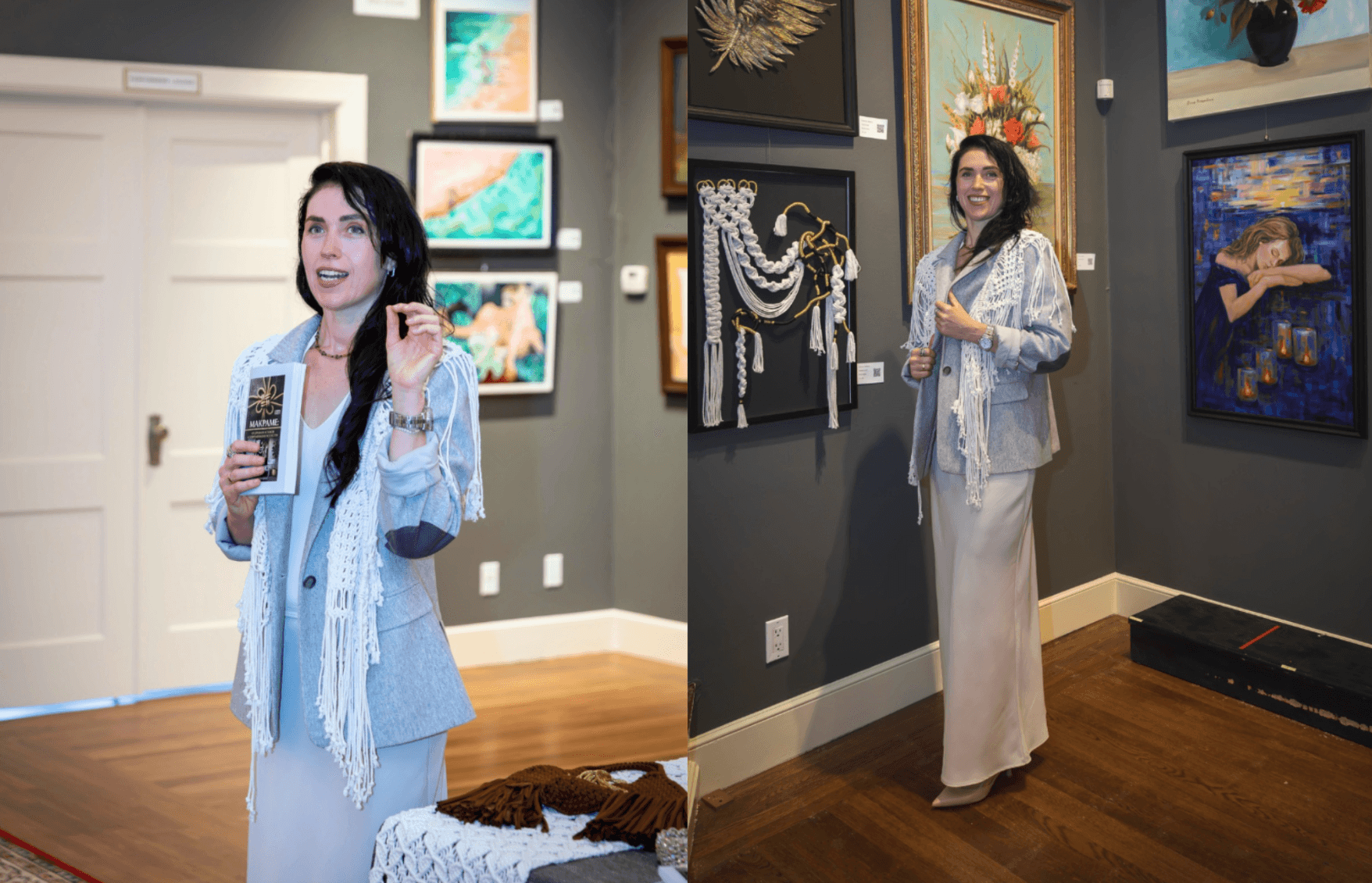
Kateryna Malikova presenting her educational publication, Macramé: From Ancient Origins to Modern Art, during her artist lecture at the exhibition; Artist Kateryna Malikova with her contemporary macramé artwork at the Spring Exhibition (Piedmont Center for the Arts, California).
Your digital platforms have reached hundreds of thousands of viewers. How do you encourage originality rather than imitation?
I believe that techniques belong to the artistic tradition, while creativity belongs to the individual.
My objective has never been to teach people how to reproduce my own work. Instead, I teach the principles of construction, composition, proportion, and material behavior so that each student can develop an independent artistic language.
When artists understand the underlying principles rather than simply copying finished designs, they gain the confidence to experiment and discover their own creative voice. Every artist brings unique experiences, emotions, and perspectives to their work, and those qualities cannot be copied. My role as an educator is to provide knowledge and technical foundations while encouraging independent thinking, innovation, and personal expression.
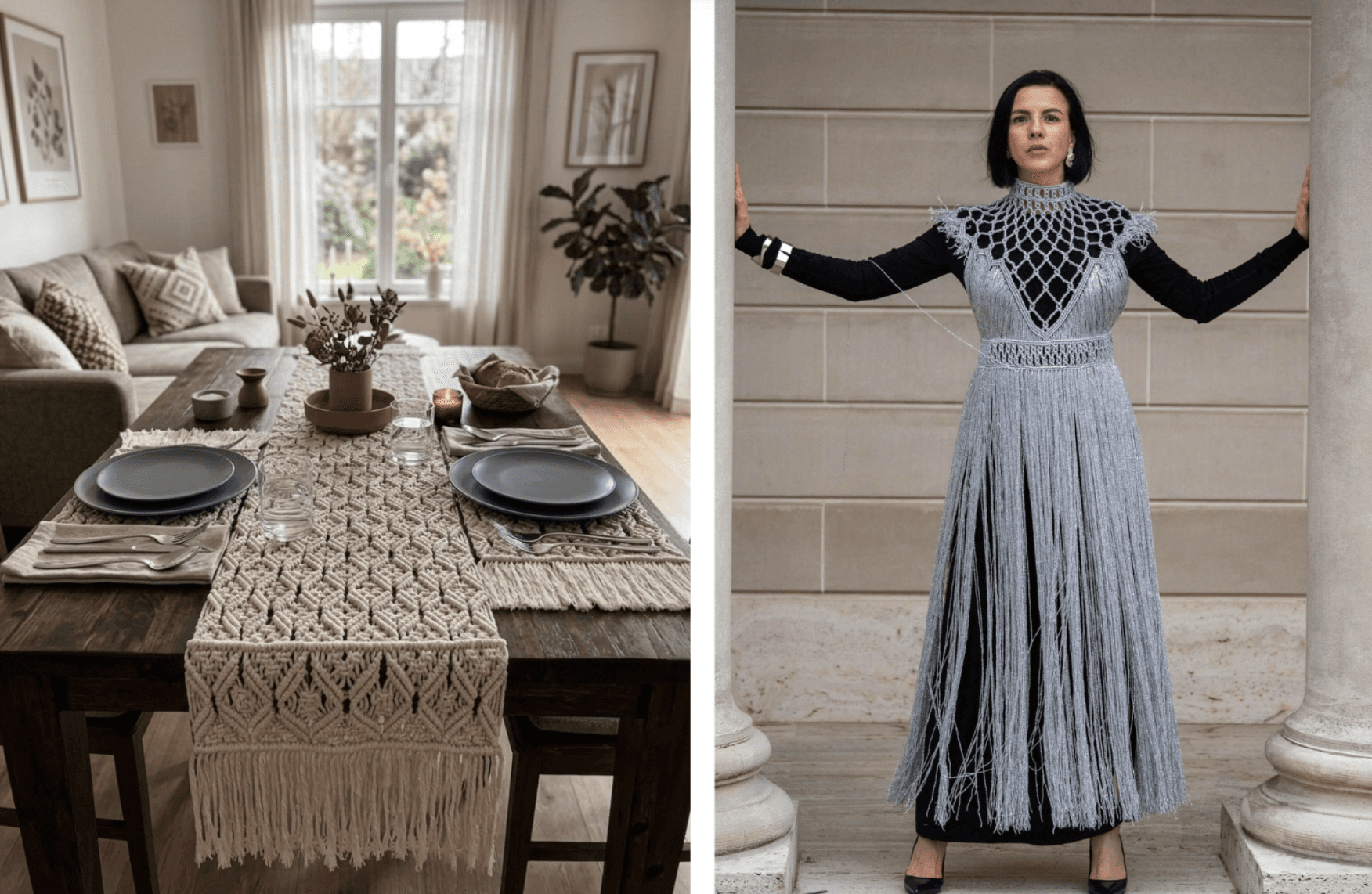
Original handcrafted macramé table runner by Kateryna Malikova, showcasing a contemporary interpretation of traditional knotting techniques; Original wearable macramé art designed and handcrafted by Kateryna Malikova, blending traditional fiber art with modern fashion.
Your work has appeared in galleries, television, and digital platforms. How do you translate textile art into virtual spaces?
Textile art is experienced through texture, scale, movement, and craftsmanship, all of which can be challenging to communicate in a digital environment.
For this reason, I pay close attention to photography, lighting, video production,and visual presentation. My goal is not only to showcase the finished artwork but also to reveal the creative process and craftsmanship behind each piece.
Digital platforms also offer opportunities that traditional exhibitions cannot. Through educational videos, close-up demonstrations, and behind-the-scenes content, viewers can observe techniques and construction methods that would otherwise remain invisible. Rather than replacing physical exhibitions, digital media expands public access to textile art, preserves traditional knowledge, and connects artists and learners across different countries and cultures.
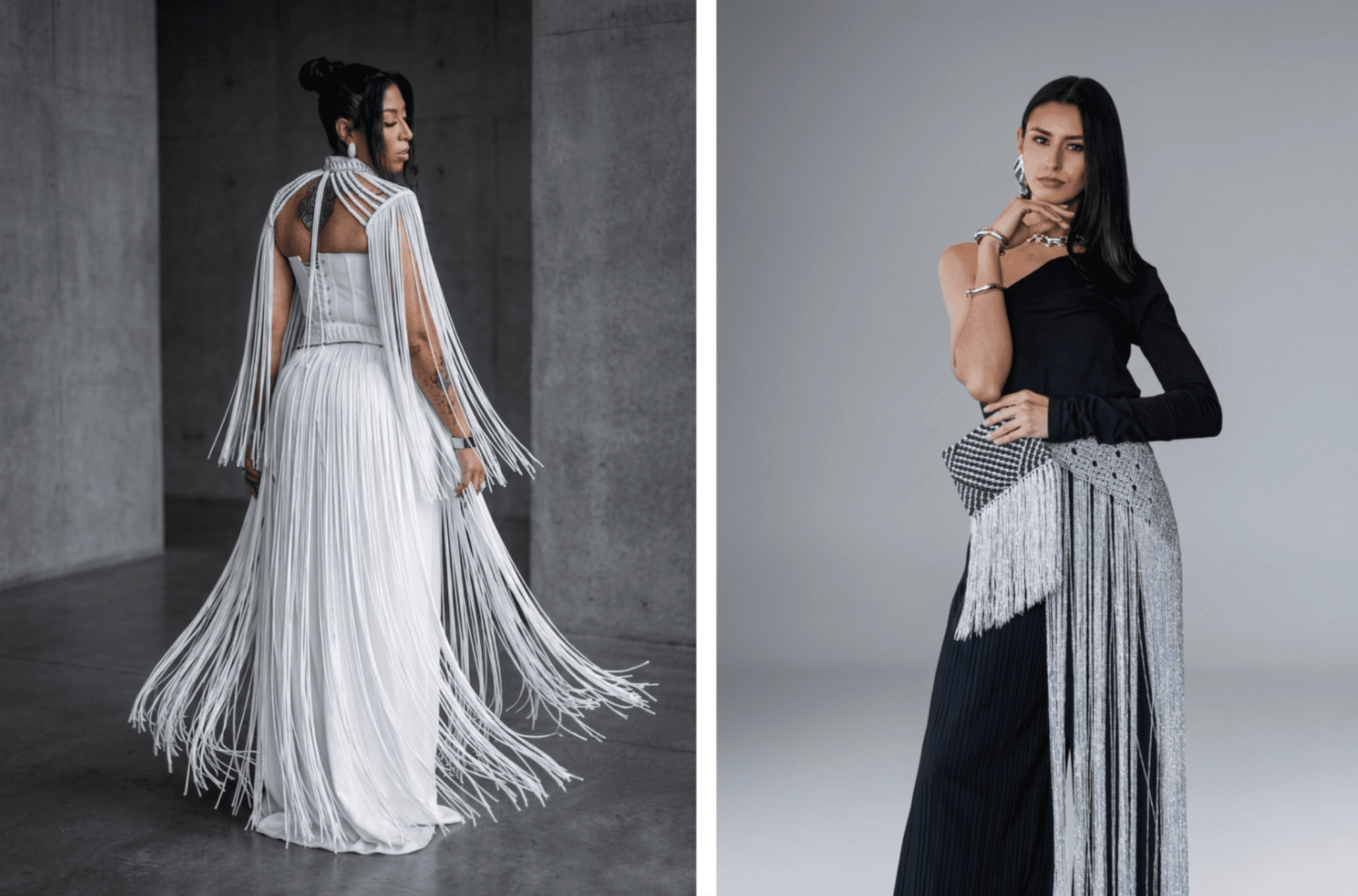
Original wearable macramé garment designed and handcrafted by Kateryna Malikova; Original macramé belt by Kateryna Malikova, combining intricate hand-knotting with modern fashion design.
As an International Jury Member, what qualities do you value most when evaluating contemporary interpretations of traditional crafts?
Technical mastery is essential, but technical ability alone does not create meaningful art.
When evaluating artistic works, I look for originality, artistic integrity, thoughtful design, and a genuine understanding of the historical techniques being used. The strongest works respect traditional craftsmanship while presenting a personal and contemporary artistic vision.
Successful contemporary craft does not imitate history—it builds upon it. I am particularly interested in artists who can transform traditional techniques into something relevant for today's audiences while maintaining authenticity and respect for cultural heritage. When technical excellence supports an original creative vision, the work contributes to the continued evolution of the discipline.
Your artistic philosophy emphasizes mindfulness and cultural appreciation. Why do you believe manual knotting remains relevant today?
The process of knotting encourages patience, concentration, and intentional decision-making. Every knot becomes part of a larger structure, requiring both technical precision and creative awareness.
In today's fast-paced digital world, handmade craftsmanship offers an opportunity to slow down, reconnect with the creative process, and appreciate the value of making something by hand. Beyond its meditative qualities, macramé preserves cultural knowledge and traditions that have been passed down through generations.
I believe traditional crafts remain relevant because they remind us that creativity is not measured by speed but by thoughtfulness, quality, and authenticity. By adapting historical techniques to contemporary fashion, design, and art, we ensure that these traditions continue to evolve and remain meaningful for future generations.
What advice would you give young designers who hope to build independent studios centered on traditional crafts?
My first piece of advice is to master your craft before focusing on building a business. Strong technical skills create a lasting foundation and establish credibility that extends far beyond temporary trends.
I also encourage young designers to remain curious, continue learning, document their work professionally, participate in exhibitions, publish their ideas, share their knowledge, and remain open to collaboration across different creative disciplines. Building meaningful professional relationships is just as important as developing technical ability.
For me, creating an independent studio is about much more than having a workspace. It is about building a creative environment where art is created, preserved, shared, and continuously developed. One of my long-term professional goals is to establish a multidisciplinary art center in California that combines an artist's studio, exhibition space, educational workshops, and a community environment where people of all ages can explore textile arts, contemporary design, and traditional craftsmanship.
I envision this space as a place where artists, designers, students, and the local community can come together to exchange ideas, learn traditional techniques, and discover new creative possibilities. Through exhibitions, lectures, workshops, and collaborative projects, I hope to contribute to preserving the cultural heritage of macramé while demonstrating its relevance within contemporary fashion, interior design, and visual arts.
Most importantly, I encourage every young artist to develop an authentic artistic voice. Originality cannot be achieved overnight—it grows through consistent practice, thoughtful research, curiosity, and the willingness to experiment while respecting the traditions that inspire our work. Every artist has something unique to contribute, and that authenticity becomes the foundation of a meaningful and lasting creative career.
Editorial & Review Credits
Editor-in-Chief & Interviewer: Elizaveta Akimova
Featured Expert: Kateryna Malikova
Editorial Review Board:
Olga Bondarenko (Award-winning designer and photographer (CAPIC, APA), Graphic Design degree (KSADA), Juno Awards photography team, and experienced art curator): "Kateryna's perspective on the importance of contributing to the community, educating oneself on specific traditional art practices in order to encourage creativity seems like a perfect example of why meaningfulness in artistic work rarely comes on its own; teaching is a part of learning & learning is a part of teaching."
Irina Naumycheva (Award-winning art strategist and creator of the "AI-Art & Design Flow 2025" methodology, recognized with the Presidential Award of the Russian Federation and distinguished as an international juror for global platforms such as Apexart (USA)): "This interview offers a compelling, scholarly look into how Kateryna Malikova elevates traditional macramé into a sophisticated medium of contemporary fiber art and innovative wearable design. It excellently traces the synergy between her studio practice at Malikova Atelier and her global educational impact, which spans an authoritative reference book and an instructional YouTube channel with over half a million views. By shifting the focus from mechanical imitation to deep technical mastery and individual expression, the text provides vital insights into preserving cultural heritage within modern creative industries, making it a highly valuable addition to the Curatone Annual Review 2026."
This article has undergone an editorial review process by members of the Curatone.art Editorial Board.
How to cite: Malikova, K. (2026). Kateryna Malikova on Transforming Traditional Macramé into Contemporary Wearable Art and Advancing Fiber Art Education. Curatone Art & Research Journal, 1(2). Retrieved from https://curatone.art/publications/kateryna-malikova-on-contemporary-macrame
Research Context & Expert References
This interview forms part of Curatone.art's ongoing interdisciplinary research initiative, "The Impact of Contemporary Art and Design on Global Social Structures." The project examines how contemporary artistic practice, traditional craftsmanship, and design innovation contribute to cultural preservation, social engagement, creative education, and sustainable development.
By documenting the perspectives of practicing artists, designers, educators, and researchers, Curatone.art seeks to explore the evolving role of contemporary art as a catalyst for cultural dialogue, historical continuity, and interdisciplinary collaboration. Through expert interviews such as this, the project highlights how traditional artistic practices — including textile and fiber arts — continue to shape modern creative industries while preserving intangible cultural heritage for future generations.
Kateryna Malikova's work represents a contemporary approach to this dialogue by integrating traditional macramé techniques with fashion design, wearable fiber art, education, and public engagement. Her artistic practice demonstrates how historical craftsmanship can be reinterpreted through modern design while remaining accessible through exhibitions, publications, and digital educational platforms.
Selected Bibliography & Academic Sources:
Malikova, K. (2026). Macramé: From Ancient Origins to Modern Art. Malikova Atelier Press.
Albers, A. (1965). On Weaving. Wesleyan University Press.
Jefferies, J., Conroy, D., & Clark, H. (Eds.). (2015). The Handbook of Textile Culture. Bloomsbury Academic.
Adamson, G. (2007). Thinking Through Craft. Berg Publishers.
Hemmings, J. (Ed.). (2012). The Textile Reader. Berg Publishers
Sennett, R. (2008). The Craftsman. Yale University Press.
Sources: https://www.malikovakaterina.com/ https://www.youtube.com/@MalikovaKaterina
Vol. 1, Issue 2 (2026)
DOI: https://doi.org/10.5281/zenodo.21427955

Featured Artists
We provide media exposure on Curatone.art and across social media for selected finalists and winners