Visual Essay
The Paradox of the Absent Presence: Emerging Traces in the Liminality
Curatone Art & Research Journal, Vol. 1, Issue 1 (2026)
Received: April 13, 2026
Accepted: May 13, 2026
Published: May 21, 2026
Keywords: Painting, Materiality, Perception, Visibility, Liminality, Charcoal, Process.
Abstract: This visual essay examines painting as a continuous process of emergence rather than a fixed image. Working with oil paint and charcoal on hand-dyed linen and canvas, I approach the surface as a site where forms appear, dissolve, and reconfigure over time. Darkness functions not as the absence of light, but as a deliberate perceptual condition that slows the act of looking and allows subtle chromatic and textural shifts to become visible. Through layering, scraping, and erasure, the work explores the interaction between viscous paint and light-absorbing charcoal, as well as atmospheric transitions captured through acrylic and pastel on panel. These material conditions give rise to a state of delayed perception, where anonymous figures and fragments hover at the precarious threshold between presence and disappearance. As the image unfolds gradually, visibility remains unstable, requiring sustained attention from the viewer. Ultimately, this essay reflects on how painting can sustain unstable states of being, where existence is most strongly felt at the moment it begins to dissipate, revealing the fragile boundary between appearance and loss.
Daun Suh is a South Korean painter based in Chicago. Her work explores the unstable boundary between presence and disappearance, where bodily forms and spatial atmospheres emerge and recede within dark tonal fields. Working with oil and charcoal on hand-dyed linen and canvas, as well as acrylic and pastel on panel, she develops surfaces through layering, erasure, and revision, sustaining perceptual ambiguity. She received her MFA from the School of the Art Institute of Chicago. Her work has been exhibited at venues including Epiphany Center for the Arts, Zhou B Art Center, and Bodock Gallery, and has been featured in New American Paintings.
Selected for the Curatone Annual Review 2026 (Academic Print & Digital Edition).
1. Painting as a State of Emergence
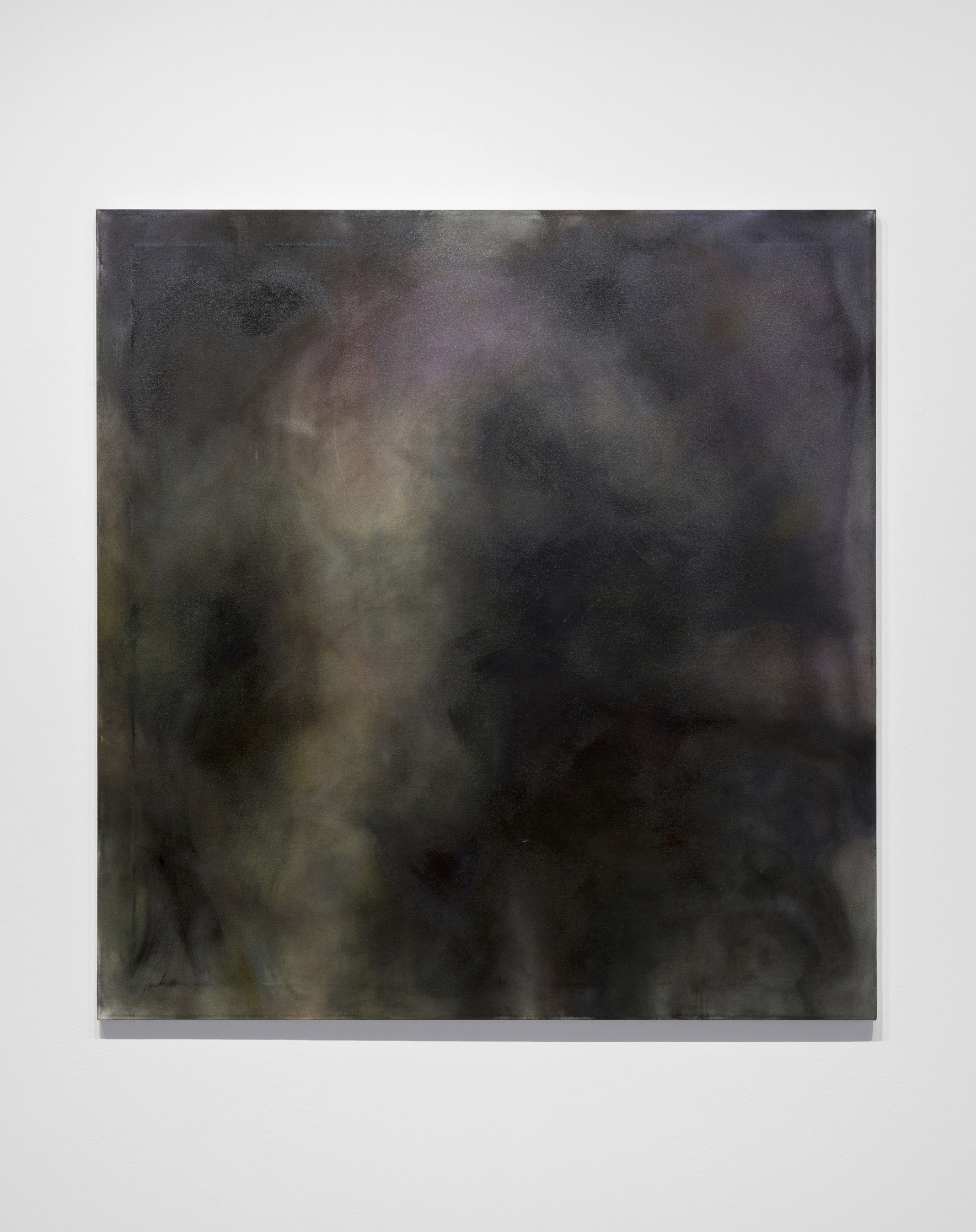
Figure 1. This is not here, 2025, oil on canvas, 122 x 127 cm.
[figure 1.] My paintings do not begin with a fixed image. They begin with a surface—often a piece of hand-dyed linen—already carrying a tone that acts as a primordial ground of light. Onto this surface, I apply layers of oil paint and charcoal, building density gradually. The image is not planned in advance; it forms through accumulation and interruption.
Painting, for me, is less about producing a final composition than about sustaining a condition in which something can emerge. It is a conceptual assemblage of fluid traces. Marks are added, blurred, removed, and reworked. At times, a figure begins to appear — a shoulder, a fragment of a torso, a contour that suggests a body — but it does not fully arrive. It remains suspended, as if caught between forming and dissolving. This state of incompletion reflects a way of thinking about painting as an ongoing process rather than a resolved object.
2. Darkness as a Condition for Seeing
Darkness plays a central role in this process. In my work, it is not simply a visual element or background; it is an atmosphere that alters how perception operates. In a visual environment saturated with brightness and speed, darkness functions as a condition that paradoxically allows perception to deepen.
It requires the eye to adjust, to search, and to remain with uncertainty. Within darker tonal fields, subtle shifts — slight variations in color, faint edges, or nearly erased forms — become perceptible only over time. When working on the surface, I build depth through repeated layering of dark tones. These layers do not create a flat blackness; instead, they produce a space that absorbs and releases light unevenly. This oscillation between visibility and obscurity is essential. The image does not present itself all at once; it unfolds slowly, resisting immediate recognition.
3. Materiality and the Surface: Cycles of Collision and Fusion
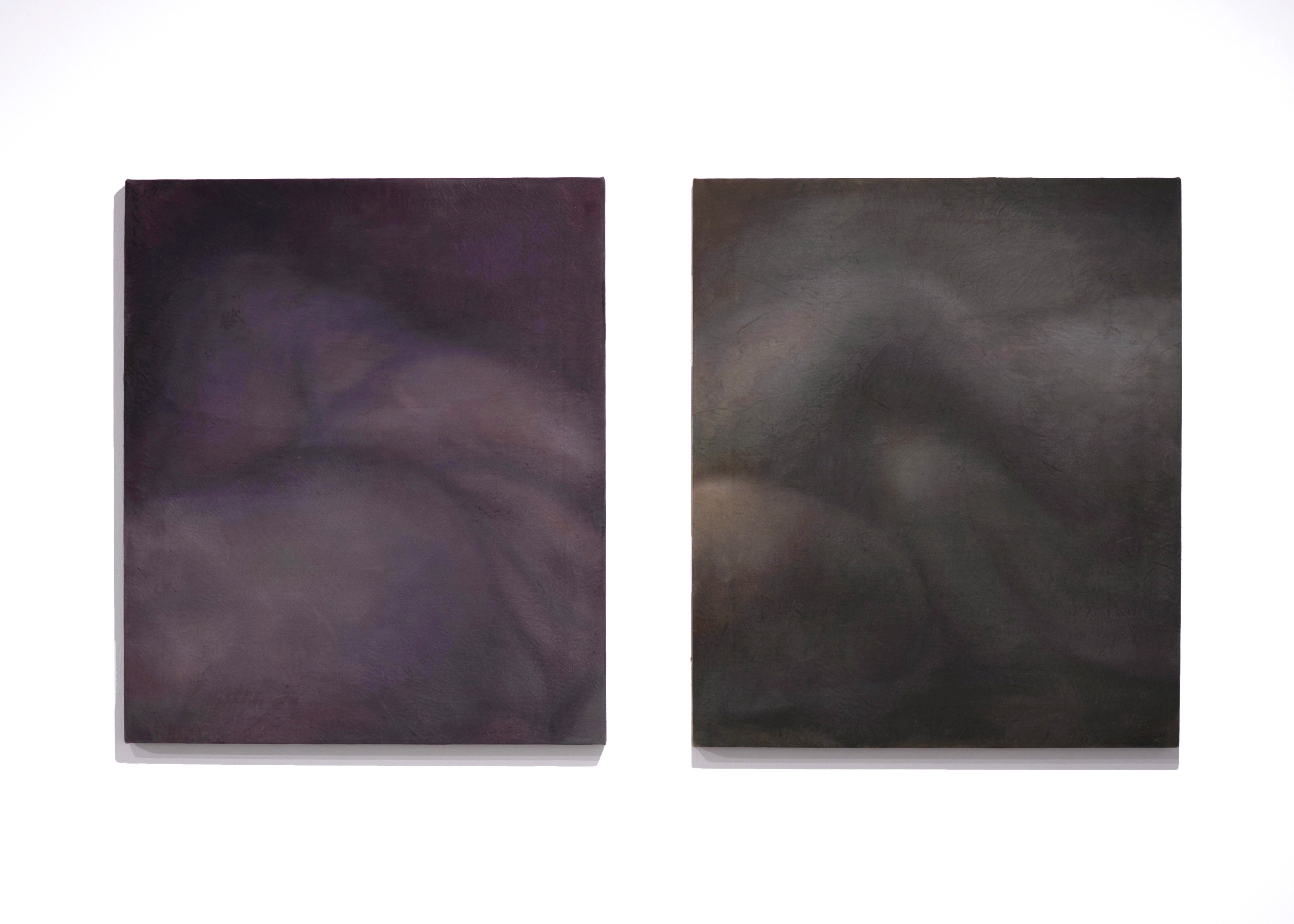
The interaction between oil paint and charcoal is central to the way images emerge. Oil paint carries viscosity and reflectivity, while charcoal is dry, particulate, and light-absorbing. When charcoal powder mingles with the viscosity of oil, they engage in a process of collision and fusion, where only fragments of the original gesture remain. [figure 2.]
Figure 2. Swelling time, 2025, oil and charcoal powder on hand-dyed linen, 71 x 76 cm each panel.
In the process of painting, I move between these materials—applying, smearing, scraping, and wiping. These actions create an unstable surface where edges soften and boundaries become uncertain. This fine, dust-like materiality of charcoal represents a trace of something that will eventually dissipate. Here, the material itself embodies the liminal attributes of life: the perpetual cycle of appearing and vanishing. The painting becomes a record of material negotiation, where each mark is subject to being altered or erased.
While the fluid interaction of oil and charcoal defines the figurative works, the landscapes utilize acrylic and pastel on panel. The fast-drying nature of acrylic combined with the dry, linear qualities of pastel allows for a different kind of layering—one that captures the fleeting, atmospheric shifts of a landscape where boundaries between earth and sky are as unstable as the figures themselves. [figure 3.]
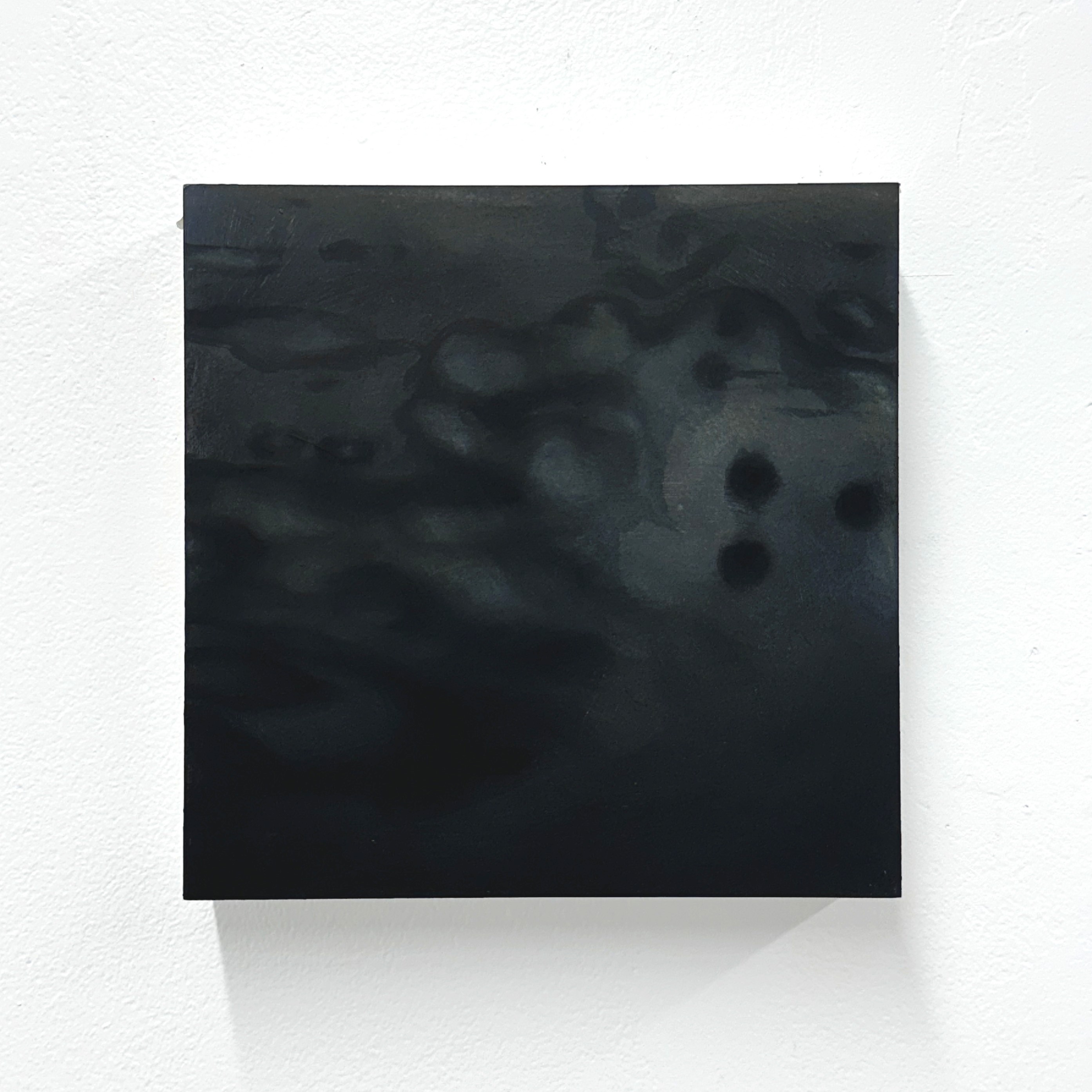
Figure 3. A ruin that fell without a sound, 2025, acrylic, pastel, and charcoal on panel, 20.3 x 20.3 cm
4. Perceptual Delay and Unstable Images
Because the image is built through layering and erasure, the viewer encounters a field in which recognition is delayed. This instability is a deliberate condition. It asks the viewer to remain in a state of looking that is active and unresolved.
At first glance, the painting may appear as an abstract dark surface. Gradually, as the eye adjusts, fragments begin to connect, forming a tentative image. Yet this image never stabilizes completely. It shifts as the viewer moves, as light conditions change, or as attention lingers. Perception becomes a process rather than a conclusion. In this sense, the work is less about representing a figure and more about staging an encounter—one in which visibility is partial, and meaning remains open.
5. The Figure as Trace: Anonymity and Existence
The human figure appears throughout my work, but rarely as a complete or fully defined body. In medium-sized works on hand-dyed linen, the figure is magnified and fragmented, emerging as enlarged sections detached from a coherent whole. In larger-scale compositions on canvas, the body may appear more fully, yet the face is strictly excluded.
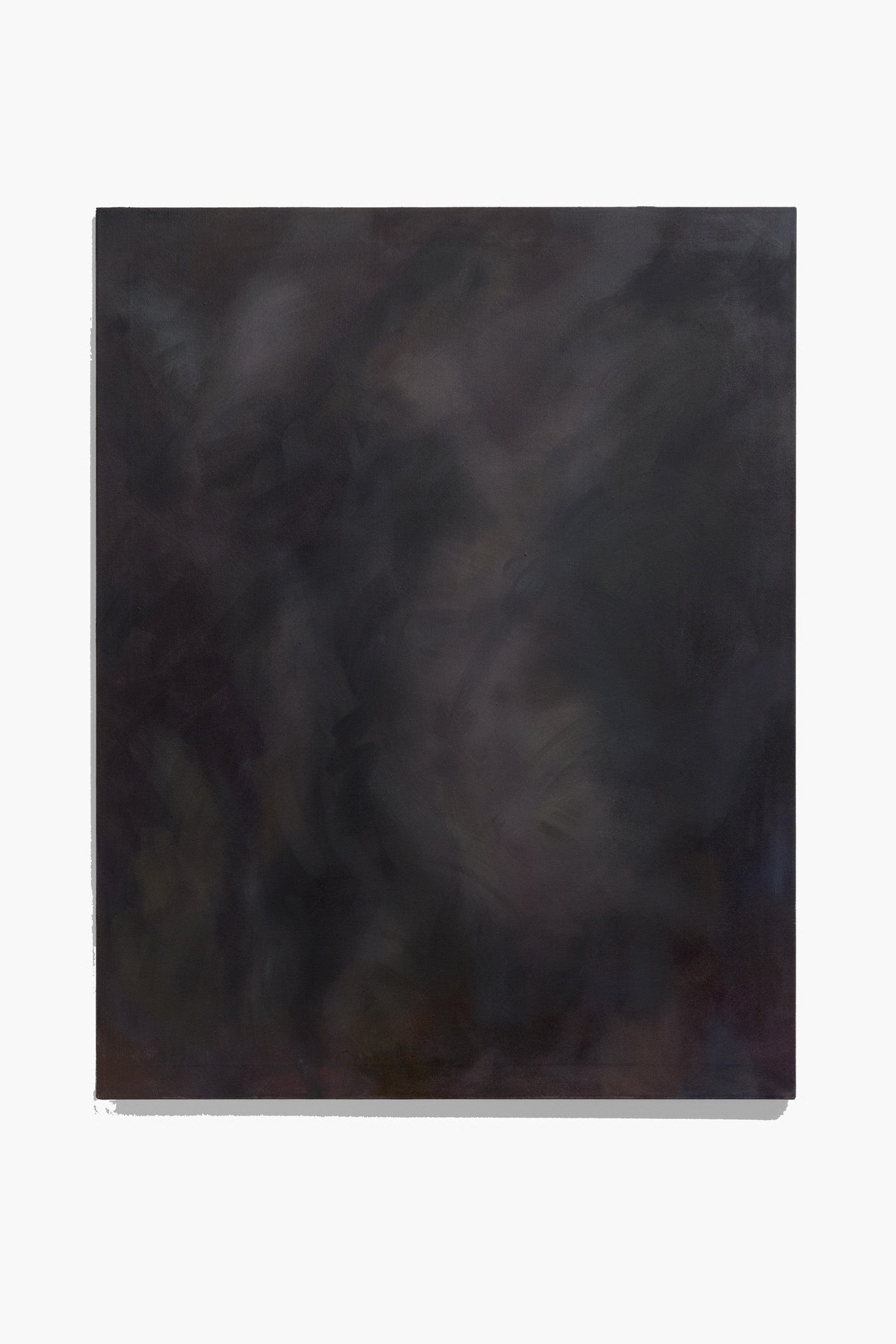
These anonymous figures function not as portraits but as traces of an internal condition. They suggest a presence that remains materially intact yet perceptually unstable, hovering at the edge of recognition. This anonymity shifts the focus away from specific identity toward a more indeterminate, “ghostly” condition of being. [figure 4.]
Figure 4. Silent thirst, 2025, oil and charcoal powder on canvas, 112 x 142 cm.
Seeping through and scattering between layers of oil paint, the figures appear suspended within the surface. They are neither fully formed nor entirely dissolved—visualizing a paradox in which presence is most strongly felt at the moment it begins to disappear.
6. Painting at the Threshold
Across these processes, painting becomes a space where boundaries are continuously negotiated: between light and darkness, material and image, presence and absence. The surface holds these tensions without resolving them. It sustains a threshold condition—one in which forms are always in the process of "becoming."
For the viewer, this means engaging with the work over time. The image does not reveal itself immediately; it requires patience and a willingness to remain with uncertainty. In this sustained encounter, painting becomes less about what is seen and more about how seeing unfolds. It is within this unfolding—between emergence and disappearance, between what can be perceived and what slips away—that the work truly exists. [figure 5.]
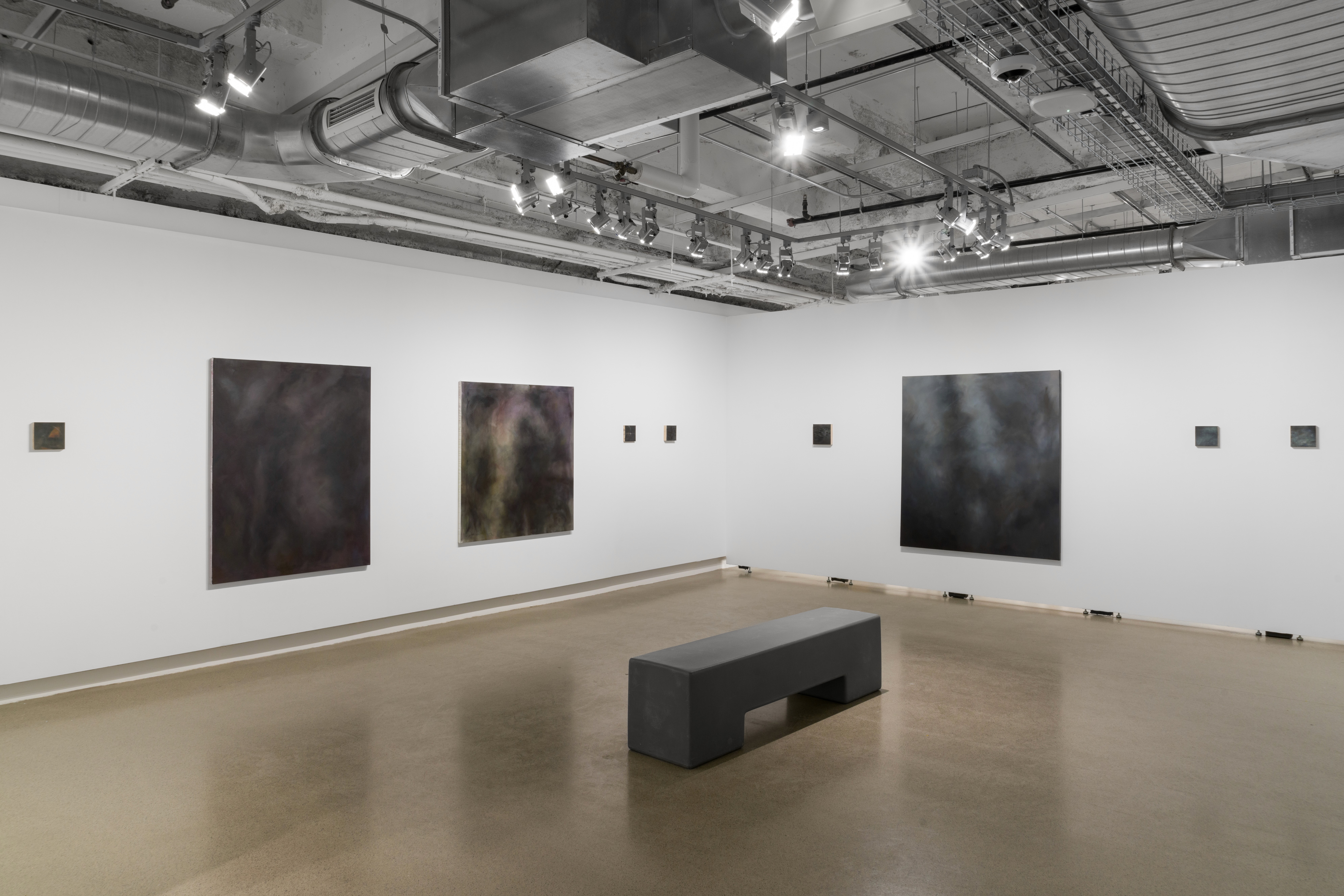
Figure 5. Installation view, 2025
Vol. 1, Issue 1 (2026)
Editorial & Review Credits
Editor-in-Chief & Internal Reviewer: Elizaveta Akimova (A professional artist and researcher with an M.Sc. in Applied Informatics and a B.A. in Graphic Design. She is an Honorable Member of the International Academy of Modern Arts and a member of the Eurasian Art Union, with her status formally recorded in the Unified Register of Professional Artists): "The research presented by Daun Suh bridges the gap between traditional fine art and contemporary visual philosophy, offering an invaluable perspective on visual construction."
Author: Daun Suh
Peer Review Board:
Valeriia Guznenkova (Award-winning contemporary photographer, member of the Eurasia Photographers Association (FIAP)): "The article leaves a very strong impression through the depth of its artistic investigation and the originality of the author’s approach to materiality and perception. The author demonstrates not only a high level of technical excellence, but also a profound understanding of the interaction between light, shadow, texture, and human presence within the space of painting. The description of the artistic process is especially compelling, as it allows the reader not only to analyze the work intellectually, but also to emotionally experience the ideas conveyed through the artwork.
I would also like to highlight the author’s courage in exploring themes of unstable presence, disappearance, and perception through such a distinctive visual language. At the same time, the article could benefit from a more personal reflection on the author’s journey: what initiated this research, how the author arrived at this specific technique, and why the combination of oil paint, charcoal, and the human body became central to the work. It would be valuable to gain a deeper understanding of what this technique allows the artist to express to the world and what personal or conceptual meaning stands behind this artistic methodology."
This article has undergone an editorial peer review process by members of the Curatone.art Editorial Board.
How to cite: Daun Suh (2026). The Paradox of the Absent Presence: Emerging Traces in the Liminality. Curatone Art & Research Journal, 1(1). Retrieved from https://curatone.art/publications/the-paradox-of-the-absent-presence

Featured Artists
We provide media exposure on Curatone.art and across social media for selected finalists and winners