Visual Essay
Tongue, Glamour, and Pause: Reclaiming the Domestic as Political
Curatone Art & Research Journal, Vol. 1, Issue 1 (2026)
Received: March 6, 2026
Accepted: March 12, 2026
Published: March 16, 2026
Keywords: feminist visual culture, domesticity, exile, care, painting, Ukraine, gendered space.
Abstract: This visual essay explores the domestic sphere as a site of feminist resistance and transformation. Through five paintings that blur the boundaries between autobiography and cultural critique, the essay reclaims the home as a charged space where trauma, care, memory, and political agency intersect. Anchored in the lived experience of exile and war, the works evoke how glamour, animals, stillness, and bodily gestures become tools of survival and testimony. The project reflects on what it means to resist through intimacy and image.
This visual essay explores how the domestic sphere can function as a political space. Through a series of five paintings, the project reflects on themes of exile, gender, care, and memory. Together, the works form a visual narrative that connects personal experience with broader cultural and feminist discourse.
What does a tongue say when it grows thorns? What does a woman wear when her power is questioned? Where does desire go when the world is forced to stop?
This series of paintings unravels the domestic sphere as a battleground of identity, control, and reinvention. Drawing from deeply personal yet culturally saturated imagery, the works move between irony and intimacy, between critique and care. The mouth becomes a site of resistance; glamour, a weapon of survival; pause, an act of defiance.
In these scenes, the home is not a shelter from politics—it is the front line.
Selected for the Curatone Annual Review 2026 (Academic Print & Digital Edition).
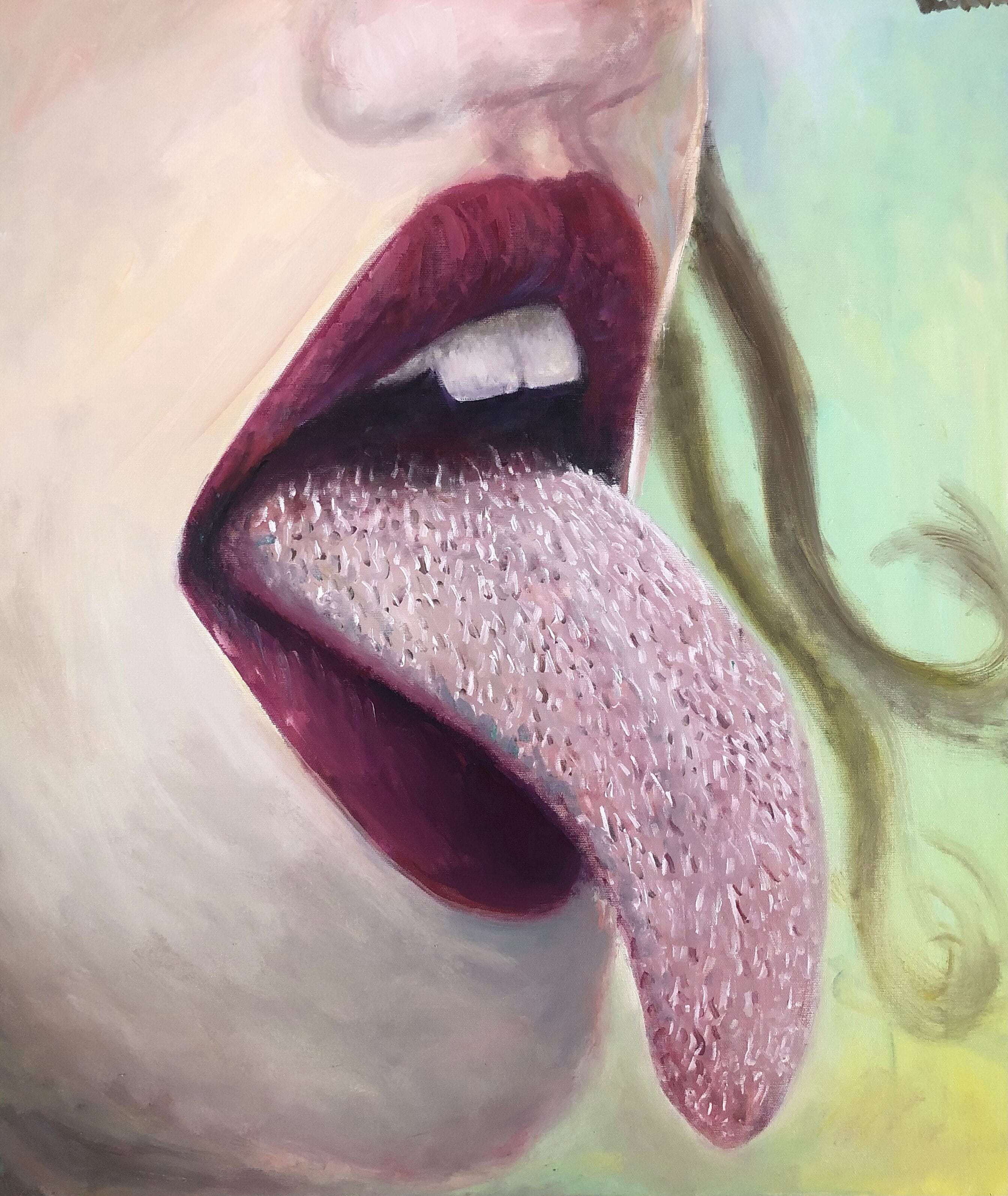
1. The Evil-Tongued Woman. Oil on canvas, 70 × 60 cm, 2021
A close-up of a woman’s mouth, vividly painted lips parted, her tongue sticking out—covered in sharp thorns. This painting provocatively challenges traditional expectations of feminine politeness and silence. The tongue here is not an organ of speech, but a weapon: it cannot be swallowed, and it is not meant to please.
The image evokes both disgust and admiration—there is aggression and self-defense in it, defiance and a refusal to be agreeable. It is a portrait of the tongue as a political body—wounding, spiky, and necessary. The work also resonates with feminist art traditions that reclaim the female body and voice as sites of resistance against historical expectations of silence.
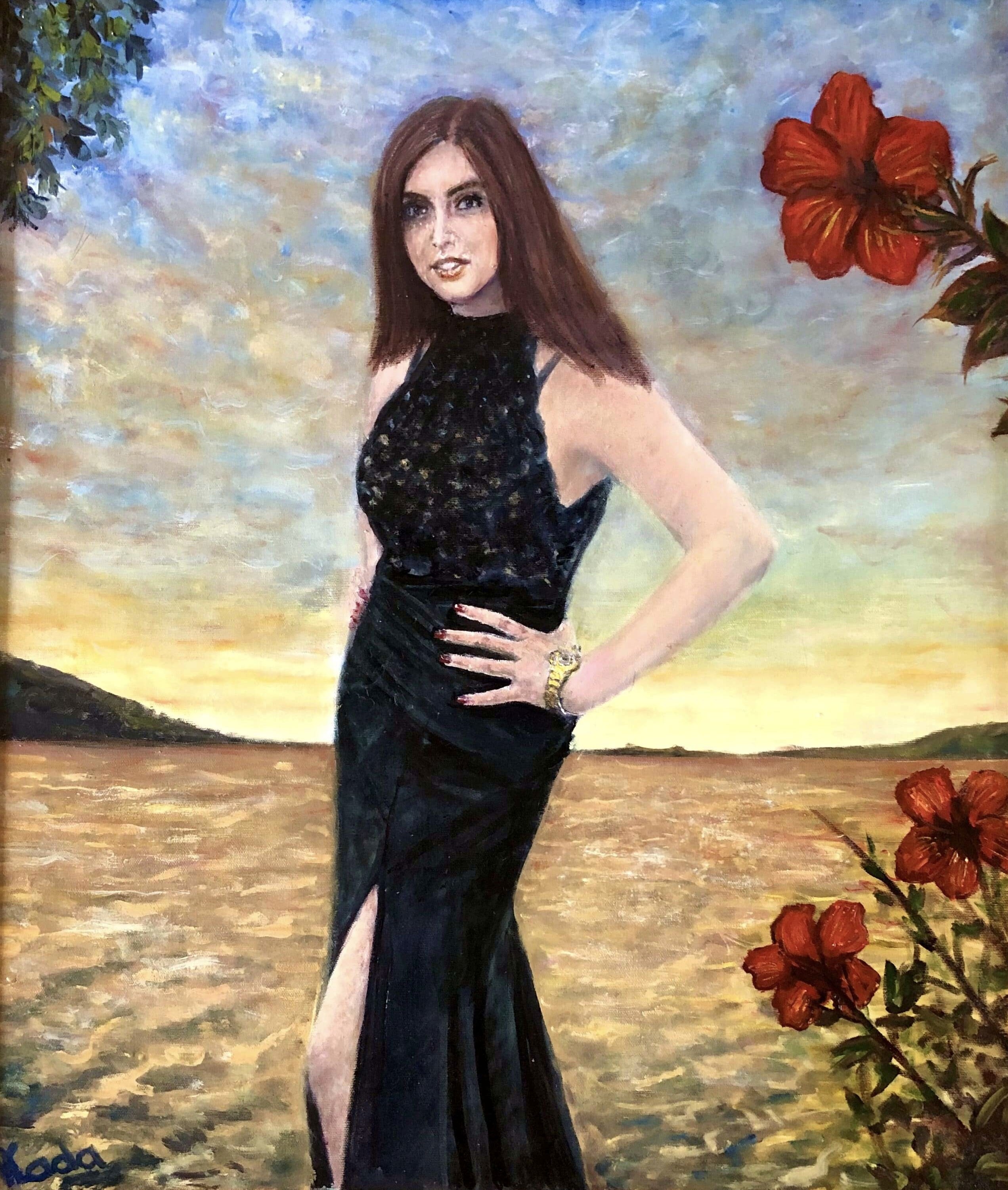
2. Ninel. Oil on canvas, 70 × 60 cm, 2021
She lives in Paris, but her heart is in Odesa—the city of her childhood, the sea, the streets filled with scents, voices, memories. She used to return often—to visit, to embrace, to breathe it in. But now the path home is cut off: the war has turned Odesa into a target, and going back has become a dream postponed indefinitely.
She wears an elegant dress and a watch, put on for her birthday. It is a gesture of resilience: even in anxious times, she chooses dignity. Behind her—golden water and flowers, an almost fairytale-like landscape that doesn’t reflect the tension within. Her gaze is direct, focused, filled with something words cannot express.
She is like a lion: silent, determined, strong. The world around her goes on living, but within her—there is war, memory, waiting. The painting speaks of women who do not fight on the front lines but bear the full weight of war. The portrait reflects a broader experience of exile shared by many women whose identities remain tied to places they can no longer safely return to.
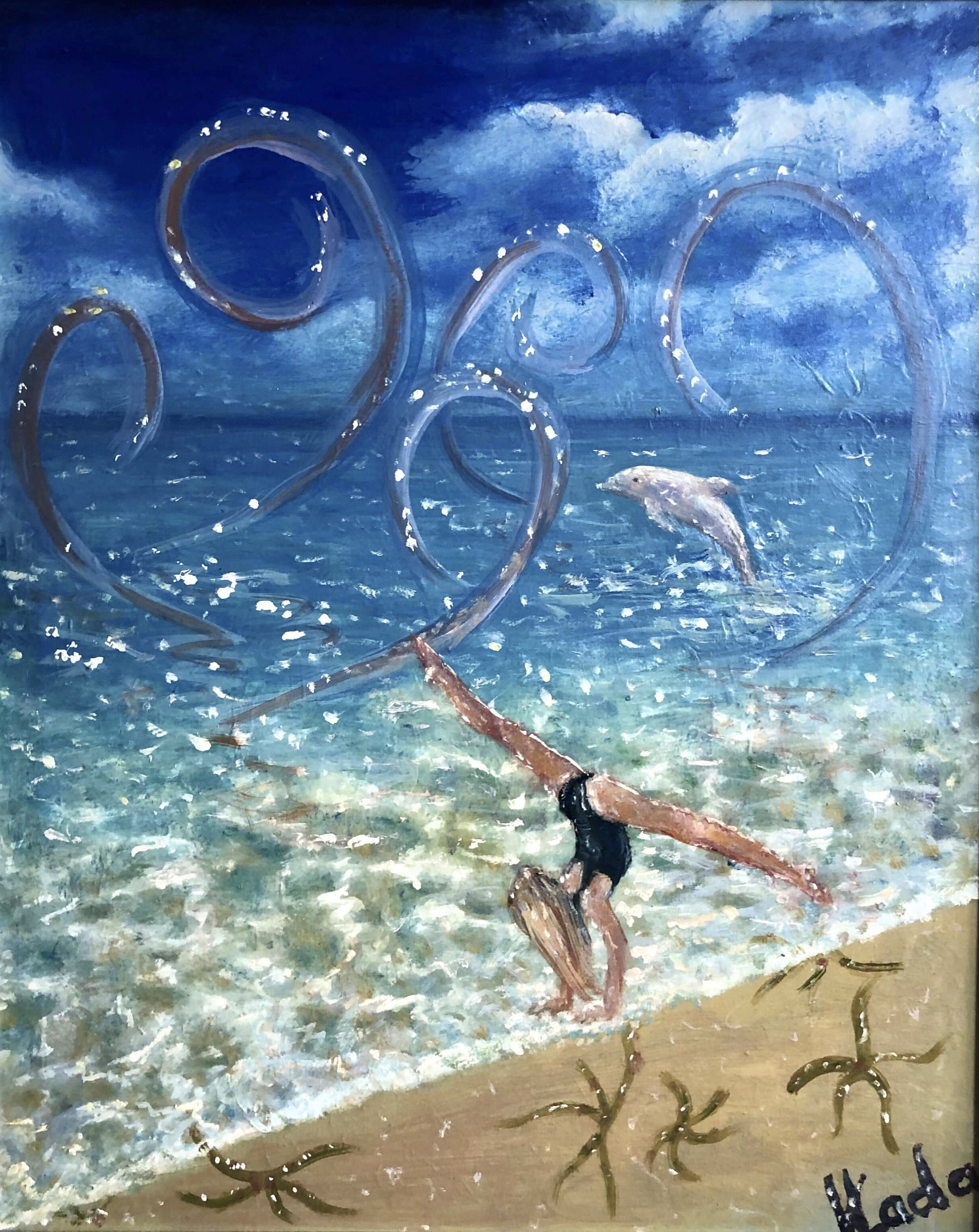
3. Fulfillment of a Wish. Oil on canvas, 40 × 50 cm, 2021
A girl does a cartwheel on the seashore. Her movement—spontaneous, joyful—is a gesture of liberation. The water sparkles around her, silvery spirals swirl in the air, and a dolphin plays in the waves.
This is not reality, but a dream. The girl is a refugee, her present filled with unfamiliar walls, longing for home, and worry for her loved ones. But her body remembers how it was before the war.
The painting speaks of a simple yet almost impossible wish: to return once more to the sea—clean, peaceful, free of mines, where dolphins do not die from explosions, and children laugh and run along the shore. The painting also speaks to the politics of memory, showing how exile transforms even a simple childhood gesture into an image of loss, longing, and imagined return.
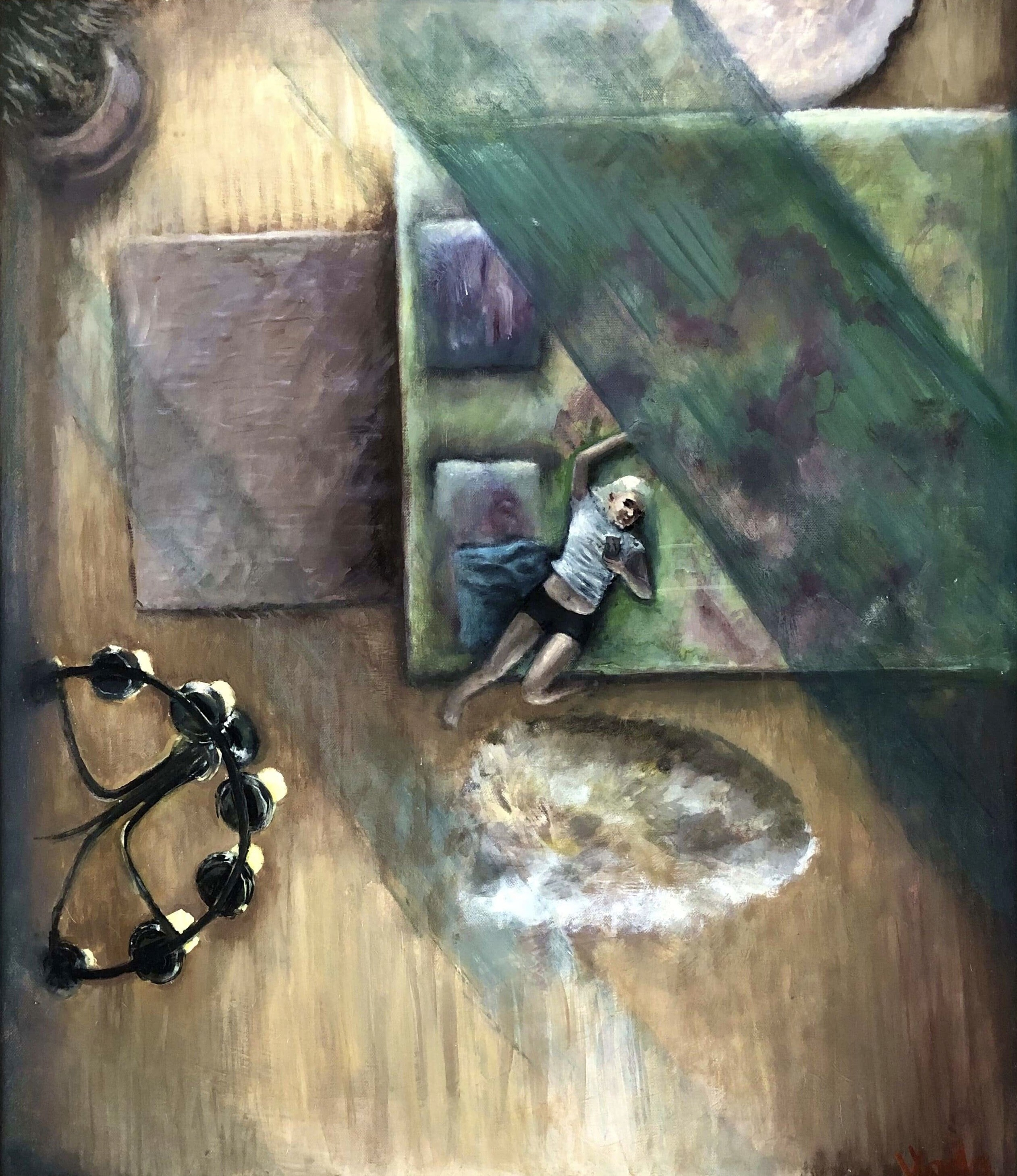
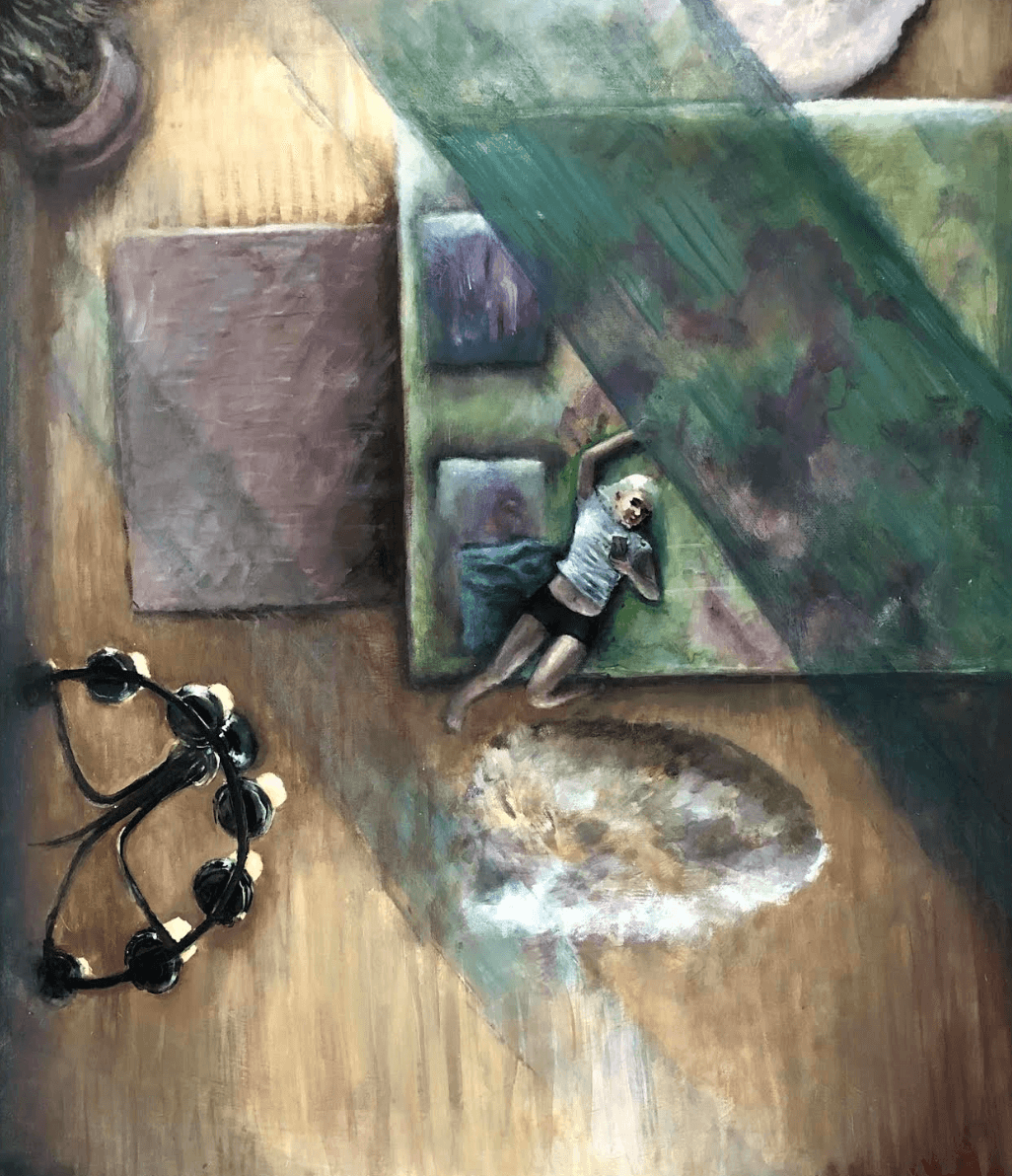
4. Coronavirus Pause. Oil on canvas, 97 × 77 cm, 2020
A woman lies on a bed, holding a phone in her hands. This is a moment of isolation—the height of the pandemic, when connection to the outside world existed only through a screen.
The room feels frozen in time, filled with tense silence. There is no movement, but there is exhaustion, anxiety, and loneliness.
This image is not about illness, but about emotional burnout. The painting reflects survival in silence.
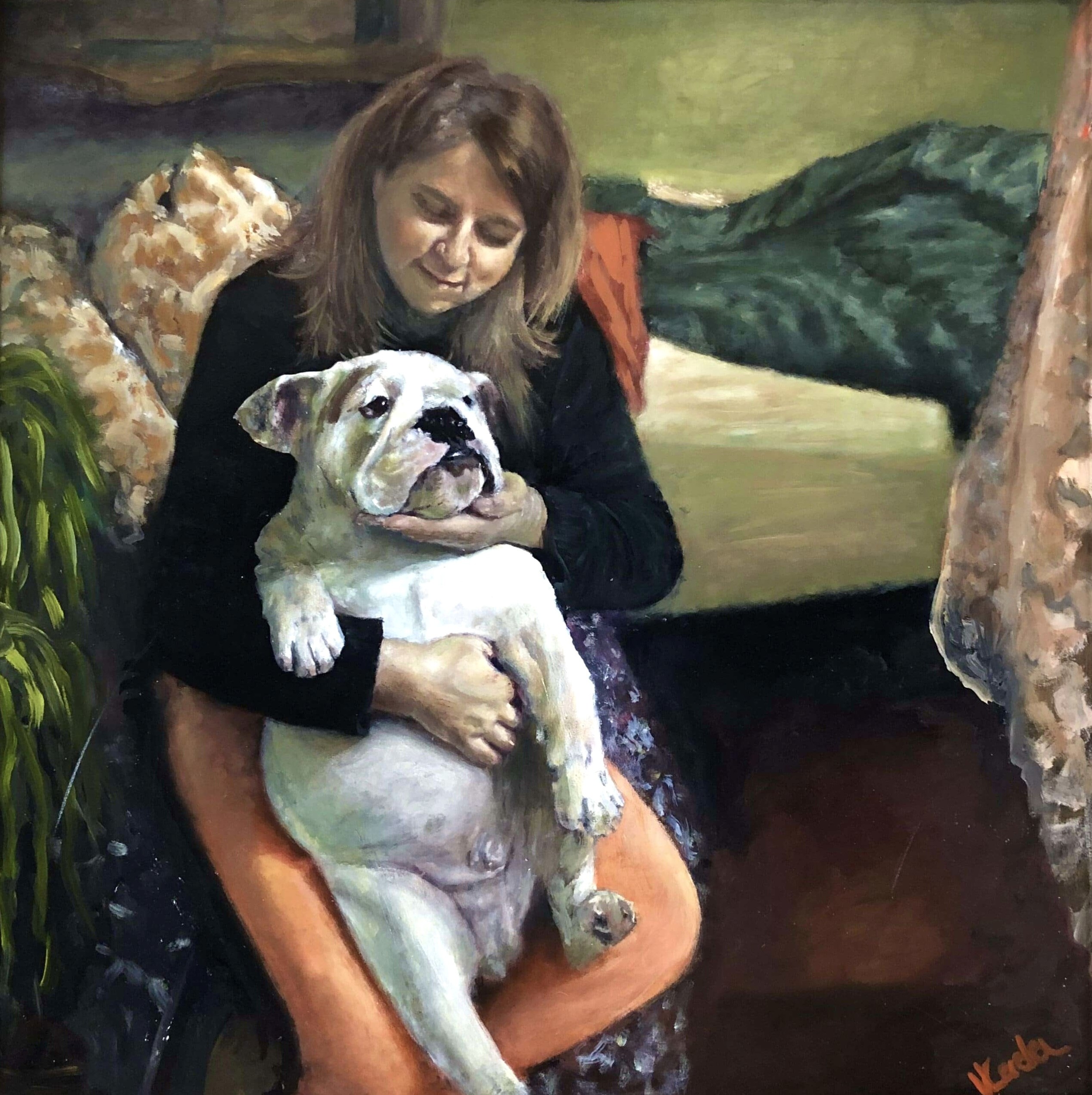
King of the Heart. Oil on canvas, 90 × 90 cm, 2020
She holds him with tenderness and calm, as if this puppy is the center of her world. The young bulldog in her arms does not appear vulnerable—on the contrary, he is confident, solid, important, as if he knows he is loved unconditionally. He is still a puppy, but already—the king of the heart.
This scene reveals the quiet joy of shared life. In the background—an ordinary setting: a bed, a blanket, some greenery in the corner. But in this ordinariness—a whole world, full of care and light.
The painting tells of that love which heals: slow, physical, rooted. The woman’s gaze—soft, attentive. It asks for nothing, but gives everything.
Editorial & Review Credits
Editor-in-Chief: Elizaveta Akimova
Author: Josephine Florens
Email: josephineflorens@gmail.com
Peer Review Board:
Xijia Cheng (Award-winning Canadian designer and creative director featured in Harper’s Bazaar, Cosmopolitan, and Glamour.): "Josephine Florens’ visual essay offers a profound and timely reclamation of the domestic sphere as a site of political agency and feminist resistance. By weaving together evocative oil paintings with sharp theoretical insights, the author provides a masterful study of how intimate, gendered spaces serve as both archives of memory and front lines of survival during times of exile and war."
Stacey Chen (MSc in Engineering Design Innovation (Northwestern), Indigo & MUSE Creative Award winner, experienced international juror): "This visual essay offers a thoughtful reflection on the domestic sphere as a space where personal memory intersects with political reality. Through symbolic imagery and intimate narratives, the artist transforms everyday scenes into sites of resistance and emotional testimony. The project contributes to ongoing conversations in feminist visual culture about voice, vulnerability, and survival."
Research Context & Expert References
Selected Bibliography & Academic Sources:
Pollock, Griselda. Vision and Difference: Feminism, Femininity and the Histories of Art. Routledge, 1988.
Boym, Svetlana. The Future of Nostalgia. Basic Books, 2001.
Hooks, Bell. Yearning: Race, Gender and Cultural Politics. South End Press, 1990.
Vol. 1, Issue 1 (2026)
This article has undergone an editorial peer review process by members of the Curatone.art Editorial Board.
How to cite: Josephine Florens (2026). Tongue, Glamour, and Pause: Reclaiming the Domestic as Political. Curatone Art & Research Journal, 1(1). Retrieved from https://curatone.art/publications/reclaiming-the-domestic-as-political

Featured Artists
We provide media exposure on Curatone.art and across social media for selected finalists and winners