Artificial Intellect
AI Art After the Hype: Authorship, Algorithms, and the New Economy of Images
Curatone Art & Research Journal, Vol. 1, Issue 1 (2026)
Received: March 6, 2026
Accepted: March 12, 2026
Published: March 16, 2026
Keywords: AI Art; Artificial Intelligence; Visual Culture; Algorithmic Creativity; Digital Art; Machine Learning; Contemporary Art.
Abstract: In recent years, artificial intelligence has rapidly transformed the landscape of visual culture and artistic production. This article examines the current condition of AI art after the initial wave of technological enthusiasm and public controversy. Rather than focusing on the technical novelty of generative systems, the discussion explores how AI reshapes the concept of artistic authorship, the aesthetics of contemporary image production, and the cultural economy of visual media. Through selected case studies—including the works of Refik Anadol, Mario Klingemann, Trevor Paglen, and Sougwen Chung—the article analyzes different artistic approaches to machine learning, algorithmic creativity, and human–machine collaboration. These examples reveal that AI art is not simply a new visual style but represents a broader shift in how images are produced, distributed, and interpreted within digital culture. By examining both the creative possibilities and the ethical challenges associated with dataset-driven image generation, this essay argues that the future significance of AI art lies less in technological spectacle and more in critical engagement with the infrastructures that shape contemporary visual systems. Ultimately, AI does not signal the disappearance of artistic authorship but introduces a new condition in which authorship becomes distributed across networks of data, algorithms, and human decision-making.
Over the past few years, AI-generated imagery has rapidly evolved from a technological curiosity into a central subject within contemporary art discourse. With the widespread accessibility of generative models, the conditions under which images are produced, circulated, and interpreted have fundamentally shifted. Yet as the initial excitement—and anxiety—surrounding AI begins to settle, the most pressing questions are no longer whether AI can produce art. Rather, the deeper issue lies in how AI is reshaping authorship, aesthetics, and the broader cultural economy of images.
Generative systems challenge one of the core assumptions of modern art history: that artistic creation is inseparable from the individual gesture of the artist. For centuries, authorship has functioned as the primary mechanism through which artworks acquire value and legitimacy. AI destabilizes this structure by introducing a distributed chain of creation. A generated image is no longer the product of a single creator but emerges from a layered network that includes training datasets, algorithm designers, prompt writers, and the machine learning system itself.
In this context, the role of the artist shifts significantly. Rather than acting solely as the maker of images, the artist increasingly becomes a designer of systems—someone who orchestrates datasets, prompts, and algorithmic processes to produce visual outcomes.
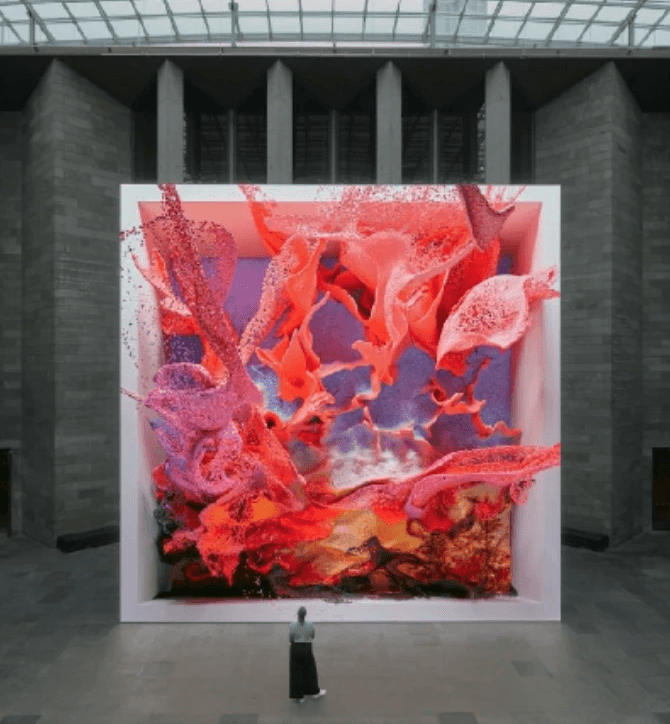
A prominent example of this shift can be found in the work of media artist Refik Anadol. His large-scale installations use machine learning models trained on vast visual archives, transforming data into immersive environments that blur the boundaries between architecture, memory, and computation.
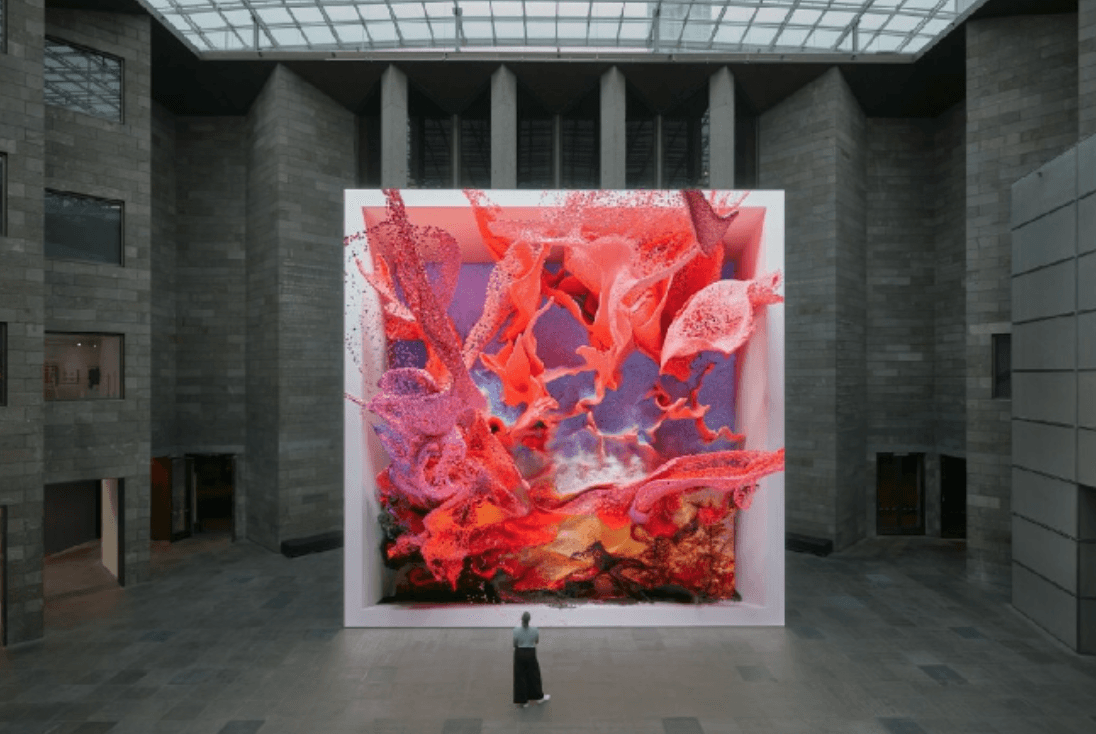
Figure 1. Installation view of “Machine Hallucinations” by Refik Anadol. The work uses machine-learning algorithms trained on massive image datasets to generate continuously evolving visual environments.
In projects such as Machine Hallucinations, millions of images are processed through neural networks that generate fluid visual landscapes. The resulting works are not “painted” in the traditional sense; instead, they emerge from algorithmic interpretations of collective visual memory. Here, the artist’s authorship resides in designing the system rather than producing each image directly.
However, much of the early visual culture surrounding AI art has been dominated by spectacle. Hyper-polished textures, surreal hybrid forms, and cinematic lighting effects have become recognizable signatures of AI- generated imagery circulating widely on social media. While technically impressive, this aesthetic often risks becoming repetitive—a visual cliché reproduced across thousands of algorithmically generated images.
The work of artist Mario Klingemann offers a critical response to this phenomenon.
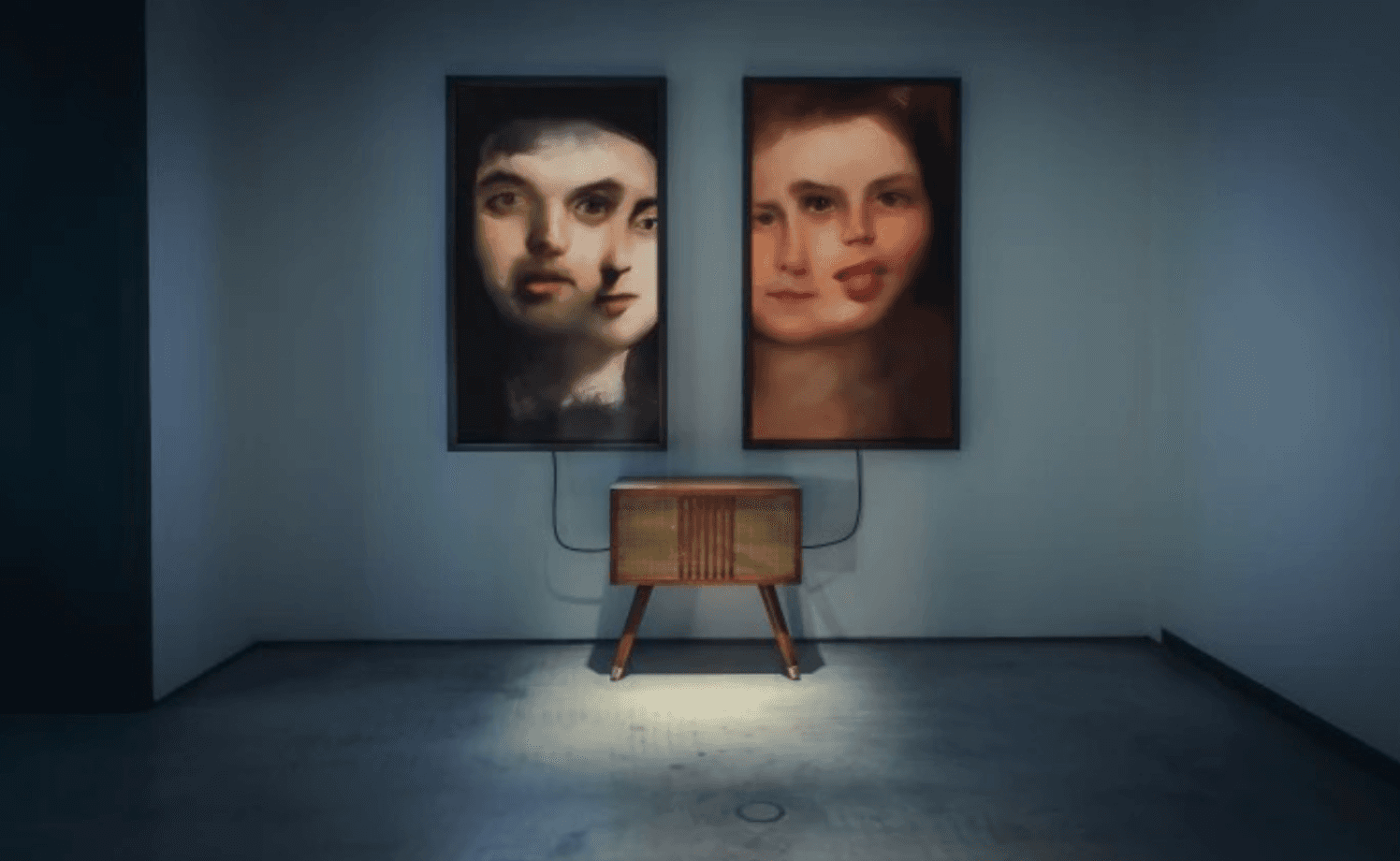
Figure 2. “Memories of Passersby I” by Mario Klingemann. The installation continuously generates artificial portraits through a generative adversarial network (GAN).
His installation Memories of Passersby I continuously produces new portraits that resemble human faces yet belong to no real individual. The project demonstrates how neural networks reconstruct visual patterns from historical image datasets, producing images that exist somewhere between memory and hallucination.
This dynamic also raises important ethical and political questions. Because generative systems rely on massive archives of preexisting images, the boundaries between influence, appropriation, and extraction become increasingly blurred.
Artist and researcher Trevor Paglen has addressed these concerns directly through projects that examine the hidden infrastructures of machine vision.
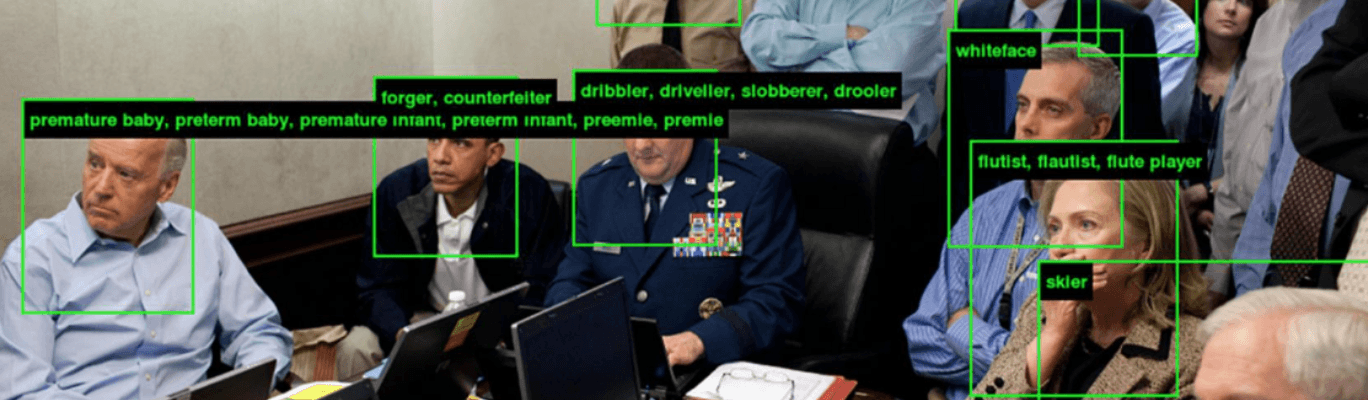
Figure 3. Interface of “ImageNet Roulette” by Trevor Paglen and Kate Crawford. The project reveals biases embedded in machine-learning image classification systems.
In the widely discussed project ImageNet Roulette, viewers upload their own photographs and receive algorithmic classifications generated from machine-learning datasets. Many results expose problematic biases, highlighting the cultural assumptions embedded in AI training data.
At the same time, generative AI has dramatically democratized image production. With only a few lines of text, individuals without formal artistic training can now produce complex visual compositions.
Artist Sougwen Chung explores this transformation through collaborative performances between humans and machines.
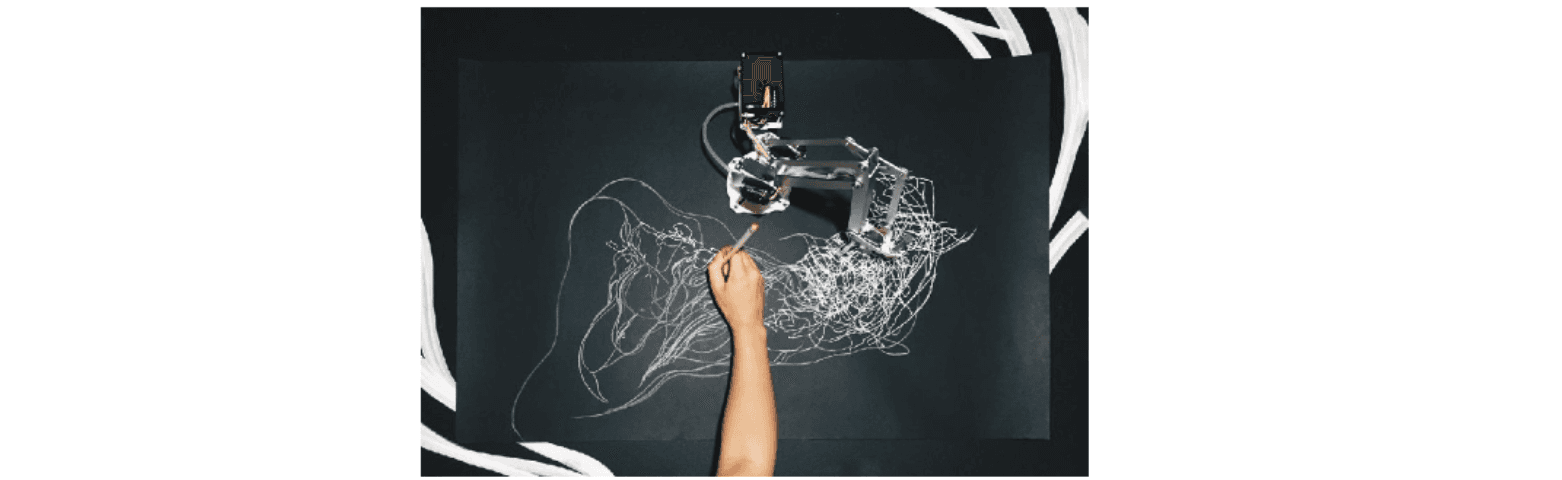
Figure 4. Sougwen Chung’s Drawing Operations performance, where robotic arms trained on the artist’s drawing gestures collaborate with the artist in real time.
In this series, machine learning models trained on Chung’s own drawing style allow robotic systems to reproduce and reinterpret her gestures. The performance creates an evolving dialogue between human intuition and algorithmic behavior.
Taken together, these examples suggest that AI art should not be understood as a singular movement or visual style. Instead, it represents a new condition of image production—one that expands artistic practice while simultaneously challenging long-standing assumptions about originality, labor, and authorship.
As the technology continues to evolve, the future of AI art will likely depend less on technical novelty and more on critical engagement. The artists who shape this field will not simply be those who use AI tools, but those who interrogate the cultural, political, and aesthetic implications of these technologies. Ultimately, AI does not signal the end of artistic authorship. Rather, it opens a new territory in which authorship becomes distributed, negotiated, and continually redefined within an increasingly complex visual ecosystem.
Selected for the Curatone Annual Review 2026 (Academic Print & Digital Edition).
Editorial & Review Credits
Editor-in-Chief: Elizaveta Akimova
Author: Anna Zhang
Peer Review Board:
Olga Bondarenko (Award-winning designer and photographer (CAPIC, APA), Graphic Design degree (KSADA), Juno Awards photography team, and experienced art curator): "It is nice to encounter extra bits of hope for the future that scares most of us. I believe the article would benefit from having a couple more elaborate comments on the current state of AI in terms of creative rights and how there is still a lot of work to get done to reach the level of cohesion within the industry the author describes. Otherwise, I enjoyed the examples & believe the article has been written with a good attention to details (whether by means of using AI or not). "
Stacey Chen (MSc in Engineering Design Innovation (Northwestern), Indigo & MUSE Creative Award winner, experienced international juror): "This article provides a clear and insightful examination of how artificial intelligence is reshaping artistic authorship and the cultural economy of images. By moving beyond the novelty of generative tools and focusing on the infrastructures behind AI image production, the author offers a valuable framework for understanding the evolving relationship between artists, algorithms, and visual culture."
Research Context & Expert References
Selected Bibliography & Academic Sources:
Anadol, R. (2022). Machine Hallucinations: Data Universe. Refik Anadol Studio.
Crawford, K., & Paglen, T. (2019). Excavating AI: The politics of images in machine learning
training sets. International Journal of Communication, 13, 100–122.
Manovich, L. (2019). AI Aesthetics. Strelka Press.
McCosker, A., & Wilken, R. (2020). Automating vision: Artificial intelligence, image culture,
and visual authority. Media, Culture & Society, 42(7–8), 1201–1216.
Paul, C. (2015). Digital Art (3rd ed.). Thames & Hudson.
Vol. 1, Issue 1 (2026)
This article has undergone an editorial peer review process by members of the Curatone.art Editorial Board.
How to cite: Anna Zhang (2026). AI Art After the Hype: Authorship, Algorithms, and the New Economy of Images. Curatone Art & Research Journal, 1(1). Retrieved from https://curatone.art/publications/ai-art-after-the-hype

Featured Artists
We provide media exposure on Curatone.art and across social media for selected finalists and winners